
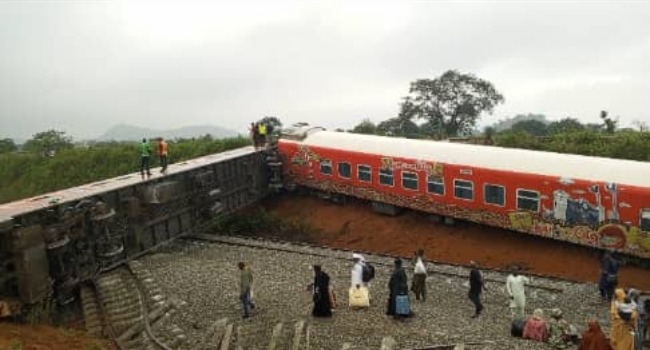
The Nigerian Safety Investigation Bureau (NSIB) has traced the Abuja–Kaduna train derailment of August 26, 2025, to poor maintenance and unserviceable equipment along the route.
The incident, which occurred at the 49 Kubwa–Asham section, left about 50 of the 583 passengers on board injured.
According to NSIB’s preliminary findings, some of the railway sleepers at Asham Station had been damaged earlier but were not replaced. Instead, they were patched, weakening the track. The report also showed that the derailment was the second recorded at the same station within 13 months. Investigators found that the automatic crossing switch at Asham was not working, and the switch point was being manually controlled with a clip that was already broken.
The bureau added that workers of the Nigerian Railway Corporation (NRC) lacked refresher training and did not have access to adequate maintenance equipment or original spare parts. In addition, monitoring devices such as CCTV cameras and other instruments were not functional.
The NSIB recommended that NRC should fully replace damaged sleepers, upgrade all switch points with proper parts, restore faulty equipment, and provide regular refresher training for its staff. It also advised that all areas marked with cautionary advisories be addressed to improve safety and reduce the risk of future accidents.
The accident happened when a train made up of eight coaches and two locomotives left Idu Station in Abuja at 9:45 a.m. and stopped briefly at Kubwa before continuing its journey. It later derailed between Kubwa and Asham, disrupting operations on the busy route.
Meanwhile, the Minister of Transportation, Sa’idu Ahmed Alkali, has announced that the Kano–Maradi railway line will be completed by March 2027. Speaking at the second Transport Correspondents Association of Nigeria summit in Lagos, he explained that work on the project had advanced to over half completion. He noted that the Katsina section of the line would be ready by December 2025.
The minister also disclosed that the Federal Executive Council had approved the construction of new bus terminals in Abeokuta, Onitsha, Warri, Kano, Lokoja, and Gombe to tackle issues of traffic congestion, unsafe parks, and poor passenger movement. He added that several ongoing rail projects, including the Lagos–Kano line, the Port Harcourt–Maiduguri narrow gauge, and the Lagos–Abuja high-speed line, were part of the government’s broader plan to modernise the transport sector.
In a related development, the Minister of Marine and Blue Economy, Adegboyega Oyetola, explained that the new National Marine and Blue Economy Policy is designed to lower logistics costs, boost trade, and attract private investments. The policy aims to connect roads, rail, ports, barges, and pipelines for smoother cargo movement.
He noted that projects such as the Lagos–Ibadan standard gauge for freight, expansion of barge services, completion of the Apapa–Oshodi Expressway, and opening of the Lekki Port Access Road were already in place. Inland dry ports in Ibadan, Kaduna, Kano, and Funtua are also being developed to ease pressure on the seaports and improve trade routes across the country.
Earlier, the chairman of the Transport Correspondents Association of Nigeria, Tola Adenubi, said Nigeria still lacked a national transport policy to guide development across all modes of transportation.