
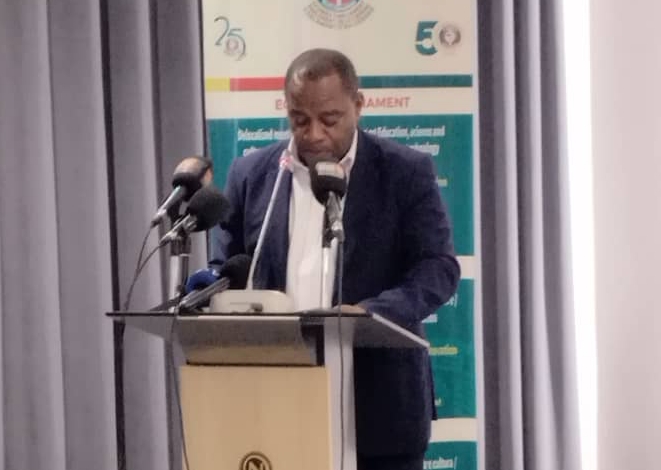
By Favour Ulebor, Abuja
Senegal’s Minister of National Education, Moustapha Mamba Guirassy, has called on African countries to stop being passive consumers of artificial intelligence and instead become creators, regulators, and innovators rooted in African values and priorities.
He made this call during his remarks at the meeting of the Joint Committee: Committee on Education, Science and Culture, Committee on Health, Committee on Telecommunications and Information Technology, themed “Prioritizing Education Technology and Innovation in the ECOWAS Region,” held on Monday in Dakar, Senegal.
The Minister said Senegal has made AI a structural pillar of its education reform, backed by a new technological deal and a national digital strategy for education (2025–2029).
He explained that Senegal had already integrated AI into its platforms for tracking school performance, trained teachers in AI fundamentals, and introduced sensitization modules for high school students to prepare them for the age of algorithmic systems.
He disclosed that Senegal’s government has committed 1,105 billion CFA to its education sector and 130 billion CFA to digital education specifically.
He said, “Africa cannot be content to consume AI. It must instill its wisdom, its memory, its vision of the world, its humanism and even its existential questions. It is not a question of integrating the dominant models, but of creating an educational AI, a bold, solidary, rooted image.
“We have the talents, we have the youth, we have the cultures. It remains for us to unite our strategies, to federate our will and to speak with a single voice to make artificial intelligence a lever of emancipation and not a factor of exclusion, a tool of sovereignty and not a channel of assertion.”
Guirassy proposed a regional West African Pact to guide the ethical and inclusive use of AI in education, built on six pillars: a regional ethical charter on AI, shared digital educational resources in African languages, a network of AI experts, teacher certification, a regional innovation fund, and data sovereignty policies.
In his remarks, Head of the Senegalese Delegation to the ECOWAS Parliament, Guy Marius Sagna, said education technology was no longer an option, but a strategic necessity.
He said the COVID-19 pandemic served as a catalyst for digital transformation in education.
He stressed that West Africa must go beyond consuming foreign technology and begin developing homegrown solutions tailored to its needs.
Sagna warned that the traditional one-size-fits-all model of education was becoming obsolete and that education technology must be used to promote equity and inclusivity, especially for vulnerable groups.
He said, “Education technologies do not only constitute the foundation that will enable us to overcome the current crisis. They represent a strategic imperative for national development.
“The ECOWAS Sovereign Journal will ensure that we are not only the consumers of these technologies, but also and above all the active players in developing innovations and integrating them.”
Co-Chairman of the Joint Committee, Orlando P. Dias, emphasized the importance of developing a strong legal and ethical framework for AI in the region.
He urged ECOWAS lawmakers to go beyond technical discussions and engage in a broader reflection on the social and political implications of emerging technologies.
Dias referenced the call by the President of the Council of Brazil during a previous ECOWAS session to consider AI as a strategic matter and to adopt a community act to regulate its development and use.
He added that the ECOWAS Parliament would combine academic research with practical field visits to ensure that future recommendations reflect the real needs and capacities of member states.
He said, “We must position ourselves as proactive, lucid and responsible players in this digital transition. It is not simply about following changes, but about dominating and putting them at the service of our vision of the world and of our peoples.
“The digital future of our region is being shaped today. Through our collective commitment, we can create a more innovative, inclusive and resilient education system that lives up to the aspirations of our young people and the demands of the 21st century.”