
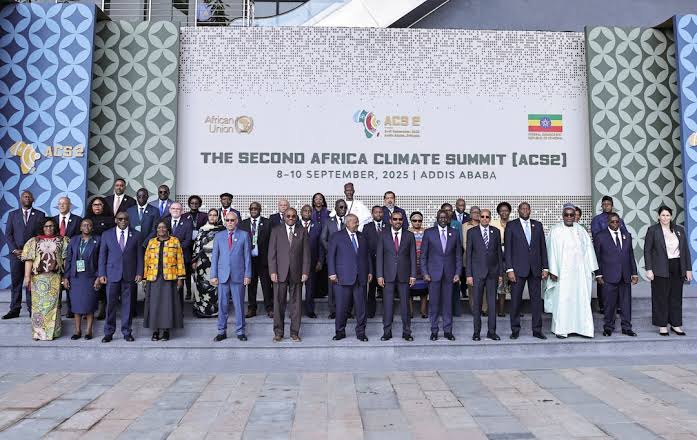
African leaders have pledged to create a new model for addressing the climate crisis, presenting the continent as a hub for green investment and renewable energy.
The announcement came on Monday during Africa’s second climate summit, hosted in Ethiopia, just weeks before COP30 talks in Brazil.
The summit opened with a strong message that Africa should not only be seen as a victim of global warming but also as a driver of solutions.
Leaders argued that the continent’s vast natural resources, youthful population, and renewable energy potential make it uniquely placed to pioneer sustainable development without sacrificing ecosystems.
Ethiopian Prime Minister Abiy Ahmed urged countries to invest in climate innovation, proposing an initiative that would unite African universities, research institutions, startups, and communities to produce 1,000 homegrown solutions by 2030.
He also signaled Ethiopia’s ambition to host COP32 in 2027.
Despite the optimism, financing remains a pressing challenge.
African governments receive only about 1 percent of global climate funding, leaving projects under-supported even as the continent experiences devastating floods, landslides, and droughts.
Leaders reiterated demands for fairer climate financing mechanisms to help vulnerable states adapt and expand clean energy capacity.
At the summit in Nairobi two years ago, Africa called for stronger financial support, but debt pressures and slow delivery of climate funds continue to hinder progress.
Many leaders now warn that the collapse of international cooperation, such as the U.S. withdrawal from the Paris Agreement and clean energy partnerships, risks undermining Africa’s climate goals.
A United Nations report released in July noted that Africa holds 60 percent of the world’s best solar potential, yet it received just 2 percent of global clean energy investment in 2024.
To close this gap, African states committed in January to building 300 gigawatts of renewable energy capacity by 2030.
China has become a growing supplier of solar technology to the continent, with imports of panels rising by 60 percent in the past year.
While South Africa led early demand, more than 20 other countries are now rapidly scaling up solar use.
The summit’s outcomes will shape Africa’s joint position for COP30, where leaders plan to push for both financing and recognition of the continent’s central role in the global green transition.