
By Ibanga Isine
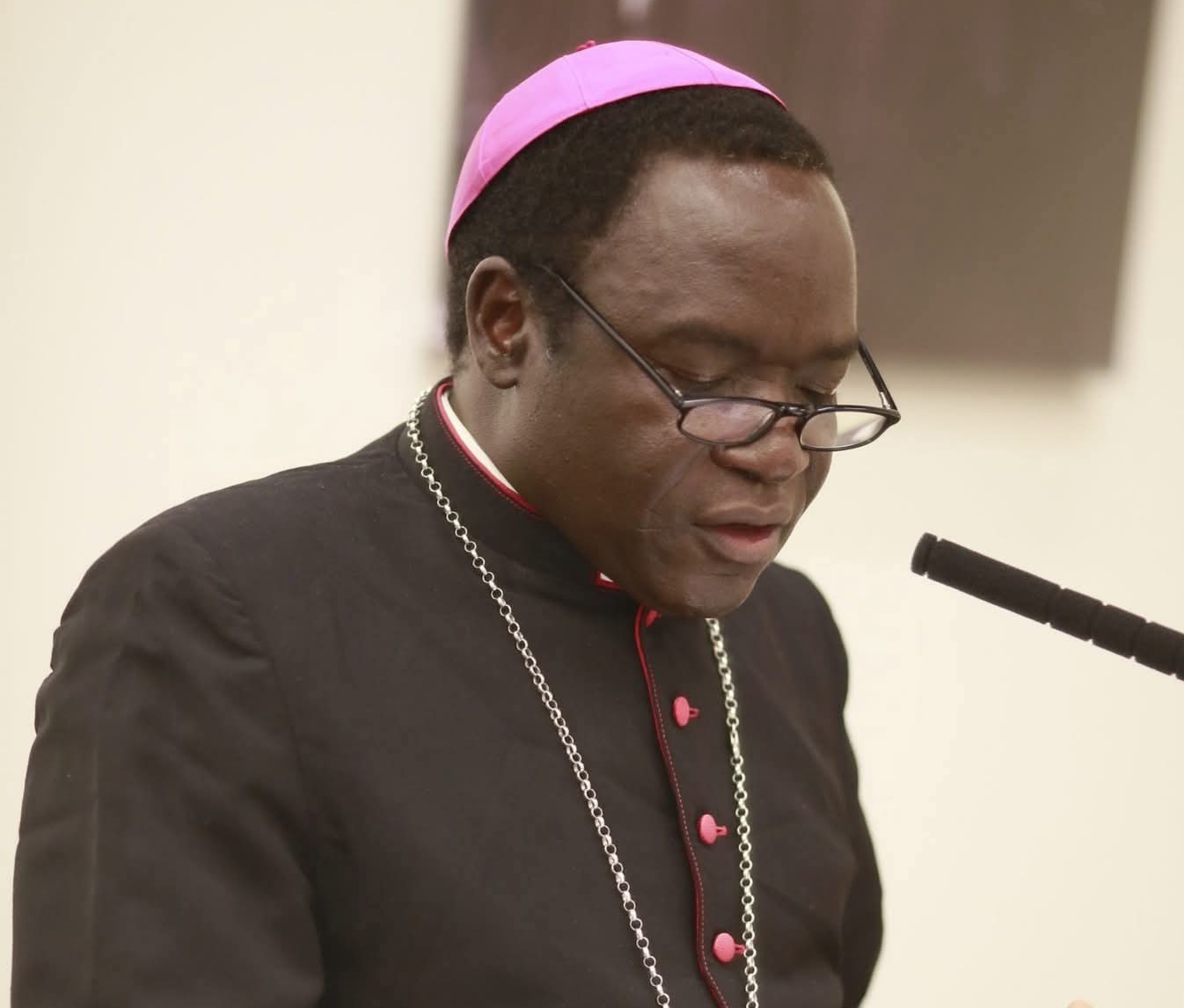
Growing up and as an investigative journalist and activist, Bishop Matthew Hassan Kukah of the Catholic Diocese of Sokoto was one of the voices that inspired me. I have never met him, and despite repeated attempts, he has never granted me an interview or contributed to my work. Regardless, I had a profound admiration for him. Bishop Kukah was one of Northern Nigeria’s most outspoken public critics of mass massacres, religious persecution, and state failure long before and after being elected a bishop. With remarkable moral clarity, he spoke to power from the pulpit, in public discussions, and through the National Peace Committee, which he cofounded. For Instance, on August 7, 2020, Bishop Kukah was quoted by an international organisation, Aid to the Church in Need, to have said that “Genocide is happening in Nigeria.” He also told the Association for Catholic Information in Africa, “It is genocide indeed.”
When his Christmas message enraged President Muhammadu Buhari in December 2020, as reported by Premium Times, Bishop Kukah was in his element, accusing the administration of failing to uphold the most fundamental constitutional duty: protecting lives and property. Kukah spoke at the time as someone unafraid of the state or death itself. That was the Kukah that many victims trusted, even from far away. But he was not a lone voice among his colleagues.
In the course of my job as an academic and an investigative journalist, I have met several Catholic leaders whose boldness matched their principles, such as the late Bishop Joseph Bagobiri of Kafanchan, Bishop Wilfred Anagbe of the Diocese of Makurdi, and Bishop Stephen Mamza of the Diocese of Yola. What struck me is that they all speak about the same tragedies in the North-Central and wider North-East. Their words are unambiguous. They have always described what has been happening as a deadly campaign against Christians and indigenous communities that has gone far beyond spontaneous clashes or isolated reprisals, as many conventional media have framed them.
In April 2016, Bishop Bagobiri delivered this same message to the United Nations during a forum organised by the Holy See’s Permanent Observer Mission and international human rights partners at the UN Headquarters in New York. Before the world, he spoke of entire villages being overrun, communities being relocated, churches being destroyed, and lives being lost in a pattern that was too consistent to be coincidental. He warned that what was happening in Southern Kaduna and the larger Middle Belt had the characteristics of systematic persecution and coordinated violence and cited a declaration by the leader of the Boko Haram sect (Abubakar Shekau), that … “the war (waged by Boko Haram) is not political. It is religious. It is between Muslims and unbelievers (arna).” Bishop Bagobiri never retracted those comments until he died in 2018.
I knew Bagobiri personally. I met him at Heathrow Airport in London in 2009, on my way back to Nigeria from a University of Westminster programme, years before I began writing about the massacres in 2014. He was warm, intellectually deep, and remarkably humble. We exchanged numbers and remained in touch till his death. In life and in death, he never used nice words to hide the horror he witnessed. Bishop Anagbe has not stopped telling the world how God’s flock under him has been depleted and places of worship and communities sacked and occupied by Fulani militia in Benue and neighbouring Nasarawa, Plateau and Taraba states. He has addressed the US Congressional Committee twice and spoken at the Vatican as well. In the North-East, at the height of Boko Haram’s onslaught across Adamawa State, Bishop Mamza opened the doors of the Catholic Diocese of Yola to the hunted and homeless. For years, hundreds of Christians and Muslims sought refuge at the camp he established. Even when bombs rained, and villages were emptied, he never stopped telling the truth about what was going on, never softened the reality of the terror brought on ordinary people, and never sacrificed the truth for safety.
The truth revisionists refuse to acknowledge is that those who kill and overrun communities do not perform incantations, pour libations, or use the name of Jesus while committing these crimes. They shout “Allahu Akbar,” consciously establishing that they are doing the work of God by killing, raping, maiming and taking over homes and farms of their victims.
One of the most destructive distortions of this tragedy is what is now commonly reported as “balanced killings” or “reprisals on both sides.” Staging isolated acts of retaliatory violence or pointing out kidnappings in unrelated contexts cannot obscure the fundamental truth of how this crisis began and has persisted. No Christian community in Northern Nigeria has ever been accused of planning and launching an extermination campaign against its Muslim neighbours. Even Bishop Kukah cannot refute this historical fact. When Boko Haram started as a deadly terrorist group, its primary and persistent targets were Christians and Christian-populated areas, and they made their mission very clear: to establish a caliphate. The first set of schoolgirls was abducted from Chibok, a largely Christian town in Borno State.
Bishop Kukah’s native southern Kaduna has frequently been drenched in blood, not because its people plotted a war, but rather because they were attacked in their own homes and sometimes in their sleep. His Grace cannot pinpoint a time in this protracted nightmare when his own relatives organised and carried out an attack against their Muslim neighbours, except during desperate actions of self-defence following repeated massacres. It would be an inversion of truth and history for anyone to blame the Southern Kaduna people for being killed in their homes and farms.
I did not leave Nigeria in 2021 because I got tired of the country. I did not leave for a better life in another country. I escaped after people who assisted me in investigating the mass killings of Christians and indigenous communities in Bishop Kukah’s Southern Kaduna were hunted down and killed. In some instances, entire households were massacred. These sources were not non-living things. They were human beings whose only crime was to tell the truth about a coordinated terror campaign against them. Before I fled, I did not know that documenting killings in Nigeria could result in death. Now I understand, and that understanding is something I take with me every day. To understand the full ramifications of what happened before ActionAid Nigeria assisted me to escape the country, read the Untold Story of Endless Massacre, Plunder by Suspected Fulani Herdsmen (Part 1, Part II, Part III, and Part IV)
Given his moral constancy in the past, I am pained and surprised by Bishop Kukah’s recent stance and subtle revisionism. The same man who once described government failure with specificity now seemed to shy from using the word “genocide” completely. He now claims that even the massacre of millions would not constitute genocide if “specific intent” could not be established. In communication studies, we say that “the medium is the message.”
When people of the same ethnic or belief system repeatedly invoke the name of their deity while slaughtering innocent women, children, and the elderly of a different faith and ethnicity, and then seize their lands and properties, the highly respected man of God must ask himself: What clearer proof of intent can anyone seek?
It is sad that Bishop Kukah’s voice, which once resonated with conviction, now appears cautious. While I am not sure about what changed him, I do know what has not: the mass graves that keep multiplying, the number of orphans that continue to increase, the displaced that keep moving into camps, and the killers that keep returning to the same places with impunity.
While revisionists and politically correct public commentators continue to deny the overwhelming and mounting evidence of a genocide against Christians in Nigeria’s North Central, North East, and North West, an inconvenient fact is staring them in the face. That reality was provided not by “Christian activists,” but by a Northern newspaper with strong regional roots and reputation. That newspaper is the Daily Trust. The paper’s editorial, titled “Genocide on the Mambila,” was uncompromising. It clearly referred to the 2017 attacks on Fulani villages in Taraba State as genocide.
The paper, which wrote the editorial based on accounts by Fulani community members, said more than 200 people were murdered, 180 villages were looted and burned, and around 4,000 livestock were butchered or injured. Based on these data alone, the Daily Trust arrived at the fact that there was moral and legal justification that a genocide had been committed under Nigerian and international law. The question that begs to be asked is:
Suppose the killing of perhaps 200 people and the destruction of property on the Mambila Plateau constitute genocide, what do we call the systematic, deliberate and continued massacre of thousands, displacements of millions and occupation of Christian communities in Plateau, Benue, Taraba, Borno, Nasarawa, and several other states over the last 10 years?
In Plateau and Benue alone, entire Christian communities have been wiped off the map in a series of planned attacks. Churches in Southern Kaduna have been burned, priests murdered, and villages destroyed. In Borno, Boko Haram specifically targeted Christians and Christian-populated communities, kidnapping schoolgirls, beheading believers, and destroying churches. In Taraba and Nasarawa, predominantly Christian rural communities have been subjected to persistent night raids, mass murders, and land seizures. The death toll is thousands, not hundreds. The displaced now number in the millions, not just a few thousand. However, the term “genocide” has suddenly become “too strong,” “politicised,” or “unhelpful.”
This selective use of words exposes a dangerous double standard. When Fulani are killed, and cattle are lost, genocide is immediately recognised. When Christians are affected, and ancestral lands are destroyed on a much bigger scale and over a much longer length of time, we are told that it is simply “farmer-herder clashes,” “communal conflicts,” or “general insecurity.” The same moral standard does not apply to Christian victims.