
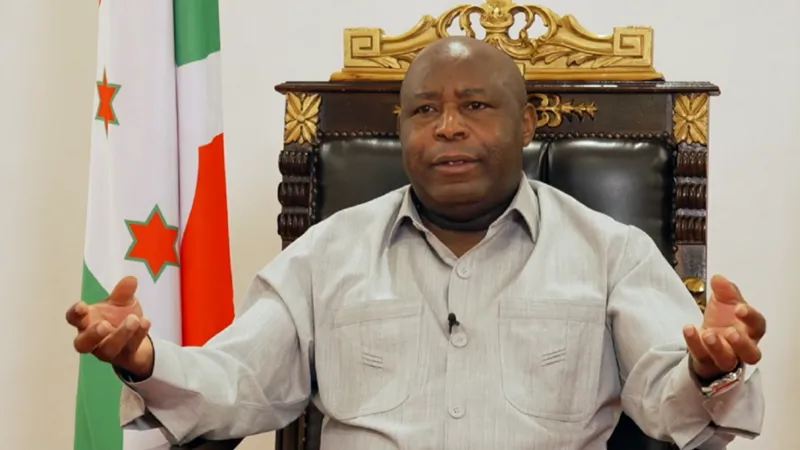
Burundi’s President Évariste Ndayishimiye has claimed that Rwanda is preparing to attack his country, citing what he calls credible intelligence.
Speaking to the BBC, he linked the alleged plan to past events, saying Rwanda had also tried to orchestrate a coup in Burundi a decade ago.
Rwanda has dismissed these allegations, describing them as unexpected and insisting that the two countries are working together on security matters along their shared border, which has remained closed for over a year. Despite repeated denials, Rwanda has faced accusations of supporting rebel groups in the region, including the M23 fighters operating in eastern Democratic Republic of Congo (DRC).
President Ndayishimiye also accused Rwanda of backing the Red Tabara rebel group, which has carried out attacks in Burundi. He stated that his country has no intention of launching an attack on Rwanda but warned that Burundians would not stand by if provoked. He urged Rwanda to respect previous peace agreements, arguing that the situation could be resolved through dialogue rather than conflict.
One of his demands is for Rwanda to hand over individuals linked to the failed 2015 coup in Burundi, whom he claims were recruited, trained, and armed by Rwanda. He believes their extradition would put an end to tensions between the two nations.
The conflict in eastern DRC has further complicated regional stability. With various militias and external players fighting over the country’s rich mineral resources, the situation has led to mass displacement. Many Congolese refugees have fled to Burundi, with some risking their lives crossing the Rusizi River on unsafe makeshift boats.
While acknowledging the humanitarian crisis, Ndayishimiye denied claims that Burundi’s border with DRC is closed. He suggested that refugees could return if they wished, though many remain trapped in camps, longing for stability in their homeland.
The growing tensions between Burundi and Rwanda, combined with the ongoing violence in DRC, have fueled uncertainty in the Great Lakes region. For now, Burundi’s leader insists that dialogue is the best path forward but warns that his country will not tolerate any act of aggression.