
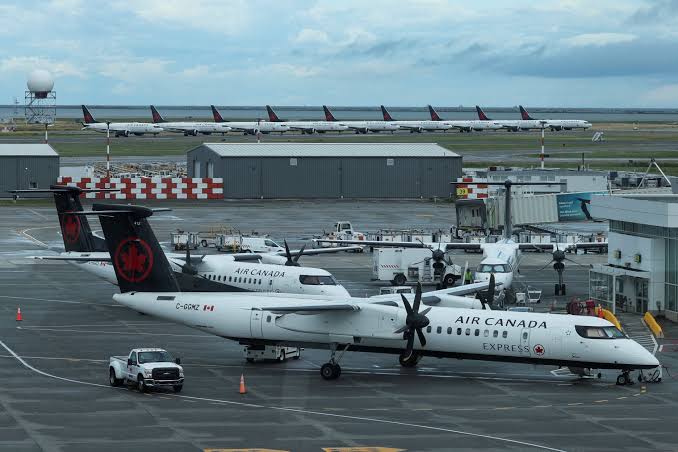
Canada government stepped in on Saturday to stop a nationwide strike by Air Canada flight attendants that had forced the airline to cancel its entire daily schedule of about 700 flights, disrupting travel for more than 100,000 passengers at the height of the summer season.
Ottawa ordered an immediate end to the strike and directed the Canada Industrial Relations Board to enforce binding arbitration between the airline and its cabin crew.
The move came after Air Canada requested intervention, while the union opposed it.
Officials said the decision was needed to keep air travel moving, protect the economy, and avoid further disruption to supply chains.
Air Canada warned that normal operations could take up to five days to restore.
More than 10,000 flight attendants, represented by the Canadian Union of Public Employees, had walked off the job demanding better wages. Currently, attendants are only paid for time in the air.
The union is seeking pay for duties on the ground, such as boarding assistance and waiting periods between flights.
Negotiations had been ongoing for months but collapsed after the union rejected arbitration proposed earlier by the airline.
The strike also threatened to impact Air Canada Rouge, the company’s low-cost division, and could have affected as many as 130,000 travelers per day.
In a country where air travel is often the only way to cover vast distances, the shutdown created major challenges for passengers across Canada.