
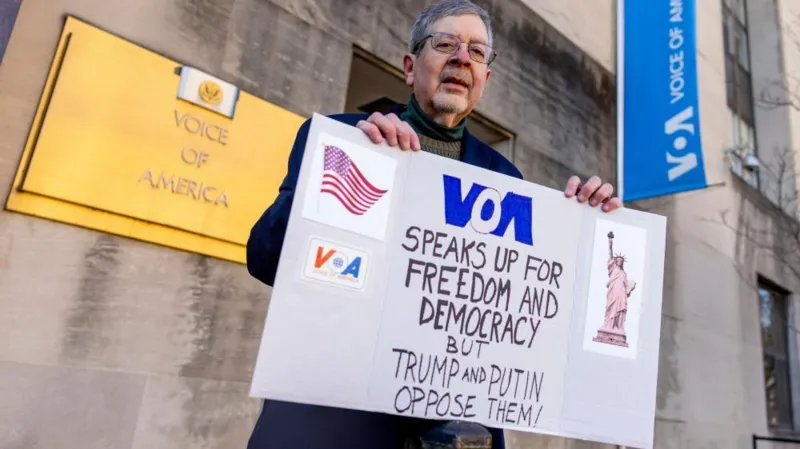
China’s state media has welcomed former U.S. President Donald Trump’s decision to cut funding for Voice of America (VOA) and Radio Free Asia (RFA), calling it a long-overdue move against what they label as biased reporting.
The cuts, which impact thousands of journalists, have sparked criticism from press freedom advocates but have been celebrated in Beijing.
The funding cuts were implemented through an executive order that halted financial support for the U.S. Agency for Global Media (USAGM), which oversees VOA, RFA, and other international news outlets. As a result, around 1,300 employees at VOA alone have been placed on paid leave. The White House defended the decision, stating that taxpayers should not be funding what it described as “radical propaganda.”
VOA and RFA have long operated in regions where press freedom is heavily restricted, providing news coverage in countries like China, Russia, North Korea, and Cambodia. Despite government efforts to block their content, many people still access their reports through shortwave radio and virtual private networks (VPNs). RFA was one of the first to report on China’s alleged detention of Uyghur Muslims in Xinjiang, a claim that Beijing denies. It has also covered human rights issues in Cambodia, a country where former leader Hun Sen praised the funding cuts as a victory against “fake news.”
The decision has been met with strong reactions from Chinese state media. The Global Times, a newspaper linked to the Chinese Communist Party, dismissed VOA as a “lie factory” that has now been “discarded like a dirty rag” by its own government. Hu Xijin, the publication’s former editor-in-chief, called the cuts “great news” and accused the outlets of spreading false narratives about China.
Journalists affected by the decision warn that eliminating VOA and RFA will leave a gap in global news coverage. Valdya Baraputri, a VOA journalist who lost her job due to the cuts, argued that shutting down independent news sources only strengthens state-controlled media that prioritize political narratives over facts.
The National Press Club, a prominent organization representing U.S. journalists, condemned the move, stating that it undermines America’s commitment to a free and independent press. VOA, which was founded during World War II to counter Nazi propaganda, reaches millions of people in nearly 50 languages. Over the decades, it has provided news coverage in authoritarian states, helped people learn English, and given a voice to those living under oppressive regimes.
Critics of the funding cuts argue that they weaken America’s global media presence while countries like China, Russia, and Iran invest heavily in state-controlled news to spread their own narratives. VOA Director Michael Abramowitz said the decision hinders the organization’s ability to counter misinformation and provide fact-based reporting in regions where independent journalism is under threat.