
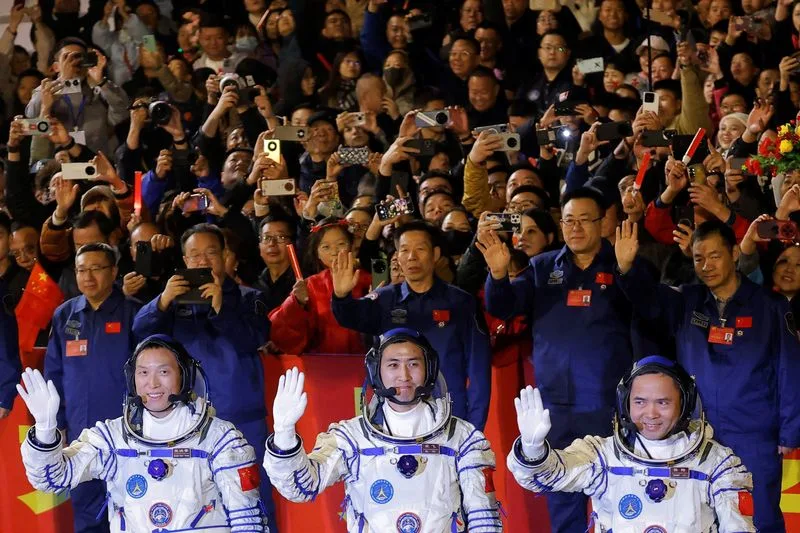
China’s Shenzhou-21 space rocket, carrying a crew that includes the youngest member of its astronaut corps, launched on Friday atop a Long March-2F rocket from the Jiuquan Satellite Launch Centre in northwest China, according to reports from Chinese state media.
This marks the seventh mission to China’s permanently manned space station since its completion in 2022.
The Shenzhou-21 spacecraft missions typically feature three astronauts who spend six months in space, with younger astronauts gradually replacing older ones. Zhang Hongzhang, aged 39, and Wu Fei, aged 32 — China’s youngest astronaut ever sent to space — were both selected to join the programme in 2020.
The mission commander, Zhang Lu, aged 48, previously took part in the 2022 Shenzhou-15 mission.
The Shenzhou-21 astronauts will relieve the Shenzhou-20 crew, who have lived and worked aboard the Tiangong, or “Heavenly Palace,” space station for more than six months. The Shenzhou-20 astronauts are expected to return to Earth in the coming days.
Accompanying the Shenzhou-21 crew are four black mice, marking the first time small mammals have been sent to the Chinese space station. The mice will be used for scientific experiments related to reproduction in low Earth orbit.
The Shenzhou programme now follows a twice-yearly launch schedule and has achieved significant milestones in the past year. These include deploying astronauts born in the 1990s, conducting a world-record spacewalk, and preparing to train and send the first foreign astronaut — from Pakistan — to the Tiangong station next year.
China’s rapid progress in space exploration has raised concerns in Washington, where the United States is pushing to return an American astronaut to the moon before China accomplishes the same feat.
Both nations are also competing to establish new international frameworks for lunar exploration — with the US-led Artemis Accords facing competition from the Chinese and Russian-led International Lunar Research Station initiative.