
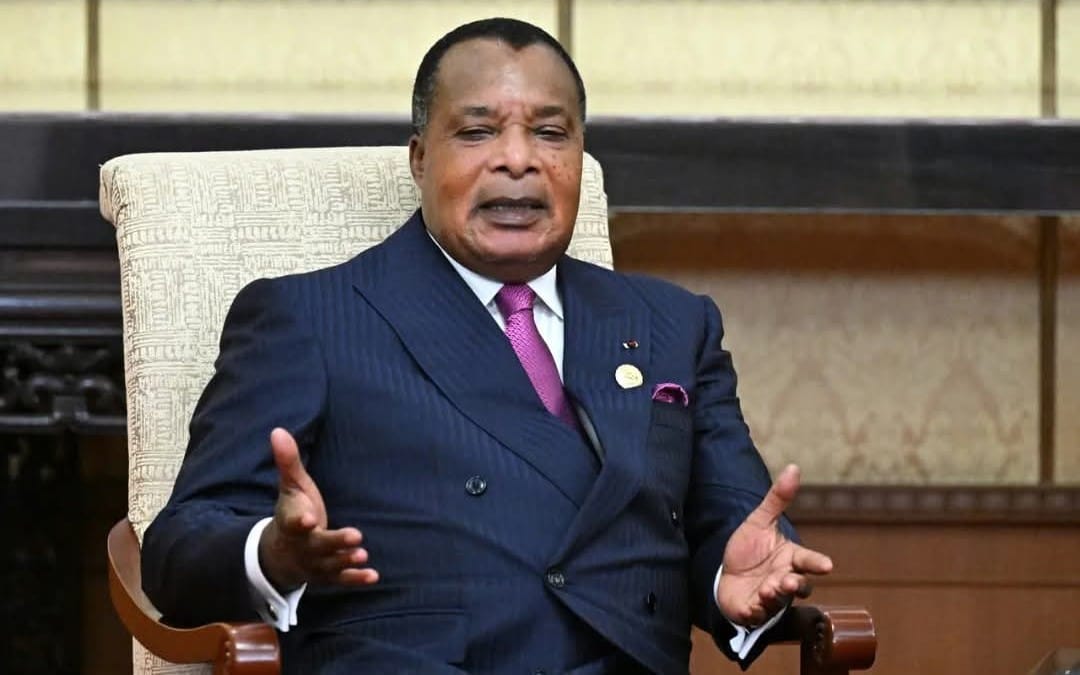
President Denis Sassou Nguesso, the 82-year-old leader of the Republic of Congo who is seeking another term in office this month, has stated that he will “not remain in power forever,” while remaining tight-lipped regarding the question of who might eventually succeed him.
In an exclusive interview with AFP at his residence in the southern city of Dolisie on Monday, the veteran leader—who has ruled the oil-rich Central African nation with an iron fist for over four decades—addressed his political longevity just weeks before the March 21 presidential election. He faces six challengers in the upcoming vote.
Sassou Nguesso, who first seized power in 1979, defended the durability of his tenure by drawing a contrast with Western democratic norms, citing high illiteracy rates in his country.
“The rules of democracy are not the same” in a nation where “50 percent or more” of the population “cannot read or write,” he told AFP.
“I see that, in Africa, the countries that have made certain progress are those that have enjoyed real stability, and even long‑serving presidents in power,” the president added.
A former French colony that gained independence in 1960, Congo-Brazzaville is endowed with significant oil wealth. However, nearly half of its six million citizens subsist below the poverty line.
The Sassou Nguesso family has long been dogged by corruption allegations, accusations the authorities in Brazzaville have repeatedly dismissed as foreign-backed attempts to destabilize the regime.
Defending his record, the president pointed to infrastructure projects—roads, ports, and universities—as well as efforts to boost agricultural output, refuting claims that the nation’s resources have been mismanaged.
“These resources have been used to bring the country to its current level, which it did not have at all when our country gained independence,” he asserted.
In a message seemingly aimed at the nation’s youth, Sassou Nguesso suggested that his lengthy rule is a precursor to a future handover. “We want young people to understand that all the work we are doing is also to prepare the conditions for their arrival,” he said. “Because we will not remain in power forever, and their turn will come.”
A career military officer, Sassou Nguesso’s political journey has been turbulent. He led the country under a one-party system from 1979 until 1992, when he lost the nation’s first multi-party elections to Pascal Lissouba. He returned to power five years later by overthrowing Lissouba in a brutal civil war in 1997. His subsequent election victories, beginning in 2002, have been systematically contested by the opposition.
His record on human rights remains under scrutiny. Non-governmental organizations and civil society groups frequently condemn the government for curbing civil liberties and threatening political dissent. Notably, two candidates from the 2016 presidential race—General Jean-Marie Michel Mokoko and Andre Okombi Salissa—have been imprisoned since 2018 and 2019 respectively on charges of “undermining national security.”
Dismissing the characterization of the jailed men as political “opponents,” Sassou Nguesso insisted they were plotting an armed rebellion. “They are not going to die in prison. One day we will release them,” he added.
If successful in the upcoming poll—which would mark another victory in a career defined by contested elections—it would be his last five-year term as permitted by the current constitution. Despite this, the octogenarian leader declined to discuss potential successors.
“It’s not a matter of grooming a particular man; it’s about a whole set of things we are preparing in a holistic way for the country’s future,” he concluded.