
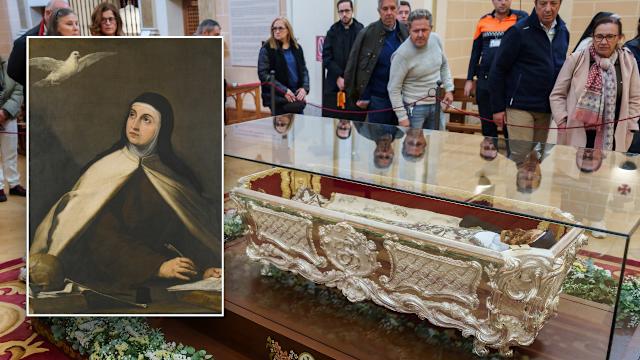
The corpse of Saint Teresa of Ávila, a prominent Spanish mystic and Carmelite nun who died nearly 500 years ago, has gone on display for the first time in a century. Saint Teresa, known for her significant contributions to Christian mysticism and her role in reforming the Carmelite Orders, passed away on October 15, 1582.
The display of her body follows a recent canonical recognition, which confirmed the body’s condition to be similar to how it was when last examined in 1914. However, observers noted that the “incorrupt” state of the corpse is disputed, contradicting previous claims.
Saint Teresa’s life was marked by her intense devotion and mystical experiences. She described four stages of ascent of the soul to God in her autobiography and used the metaphor of a castle with seven mansions to illustrate the journey of faith in her work, “The Interior Castle”. Her writings offer profound insights into the nature of prayer, contemplation, and the relationship between the soul and God.
She was canonized by Pope Gregory XV in 1622 and later declared the first female Doctor of the Church by Pope Paul VI in 1970. Her legacy extends beyond her writings, with her reforms of the Carmelite Order and her influence on notable theologians such as Francis of Sales and Fénelon. The devotion to the Infant Jesus of Prague is also attributed to her legacy, although there’s no direct historical link between her and the famous statue.
As news of the display spreads, many are expected to flock to pay their respects to this influential figure in Christian history. Saint Teresa’s impact on Catholicism and her enduring legacy make her a significant figure, and the display of her body provides a rare opportunity for devotees to connect with her physical presence.
The Catholic Church has a long tradition of venerating relics, and the display of Saint Teresa’s body is likely to attract pilgrims and devotees from around the world. Her life and writings continue to inspire and guide those seeking a deeper understanding of their faith, and the display of her body serves as a reminder of her enduring legacy.