
Wildfires tearing through South Korea’s southeastern regions have left at least 19 people dead and forced thousands to flee as firefighters battle to contain the destruction.
The fast-moving blazes, driven by dry air and strong winds, have also reduced a centuries-old Buddhist temple to ashes.
The fires began last Friday when a spark from a lawn mower ignited dry grass in South Gyeongsang Province. Since then, the flames have spread rapidly across multiple areas, including Uiseong and Andong, endangering historical sites and communities. Officials say more than 17,000 hectares (about 43,000 acres) of land have already been consumed.
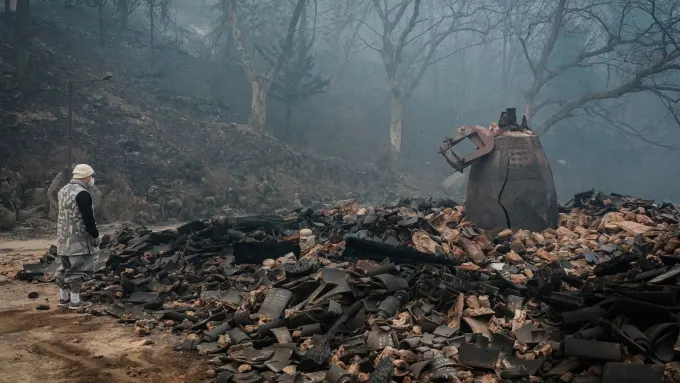
One of the most devastating losses is the 1,300-year-old Gounsa Temple in Uiseong County. The ancient Buddhist site, known for its rich history and cultural treasures, was almost completely destroyed, with only its ceremonial bell left standing. Some valuable artifacts, including a state-designated seated stone Buddha, were saved after being relocated to other temples before the fire arrived.
The disaster has claimed the lives of firefighters, civil servants, and residents, while dozens more have suffered injuries. The worsening conditions prompted the South Korean government to declare a state of emergency for several affected regions, including Ulsan and parts of Gyeongsang Province.
With the fires threatening the UNESCO-listed Hahoe Folk Village in Andong, authorities ordered evacuations and deployed firefighters to protect its traditional wooden houses. The strong winds and dry weather have made containment efforts challenging, with officials reporting that only 68% of the fires in key areas had been controlled by Wednesday.
The crisis took another tragic turn when a firefighting helicopter crashed in Uiseong while attempting to suppress the flames. The pilot, the only person on board, was killed, leading officials to ground all firefighting helicopters temporarily.
Prime Minister Han Duck-soo, who is also serving as acting president, called the fires the worst the country has faced in recent years. He urged authorities to focus all efforts on extinguishing the blazes before they spread further.
The Korea Forest Service has raised its wildfire alert to the highest level, restricting access to forests and parks while deploying additional resources to combat the flames. Weather officials have issued a dry weather warning for the affected regions but remain hopeful that expected rainfall on Thursday could aid firefighting efforts.
Although wildfires are common in South Korea during the dry months of February to April, this year’s outbreak has been particularly destructive. So far, 244 wildfires have been reported across the country, marking one of the worst fire seasons in recent memory. With entire communities displaced and historic landmarks lost, the country faces a long road to recovery once the flames are finally extinguished.