
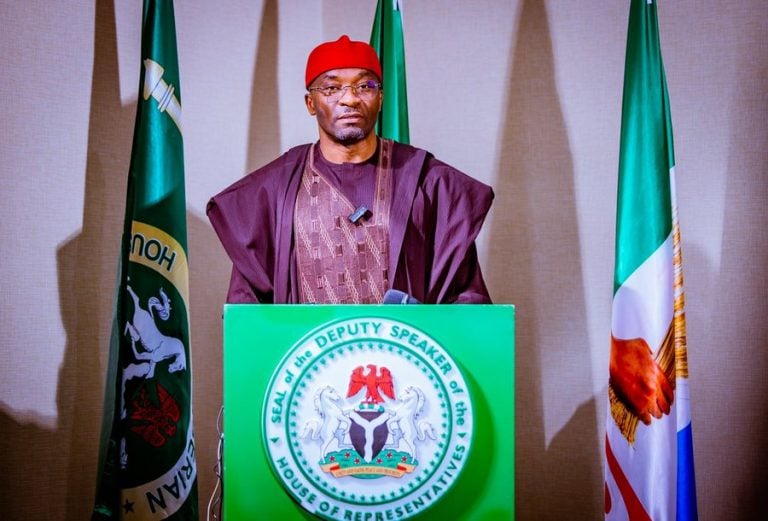
The Deputy Speaker of the House of Representatives, Benjamin Kalu, has said that Nigeria needs a constitution capable of allowing its democracy to thrive.
Kalu made the declaration at a consultative session with the National Chairmen, secretaries and women leaders of the registered political parties in Abuja on Monday.
The Deputy Speaker, who also doubles as the Chairman of the House Committee on Constitution Review, told his audience that although the nation has witnessed a giant leap in its democratic journey since 1999, more needs to be done to make democracy work not only on paper but in reality, for the benefit of Nigerians.
The 10th House, led by Speaker Tajudeen Abbas in collaboration with the Senate, is reviewing identified clauses of the 1999 Constitution in a bid to deepen governance and make democracy count for the people.
Having identified such areas as power devolution, independent candidacy, local government autonomy, state police and special seats for women, the Kalu-led committee embarked on a nationwide tour of the six geo-political zones recently, holding stakeholders’ engagements with various groups.
The Committee has pledged to make available the final draft of a reviewed constitution to the parliament for consideration and adoption in December 2025.
In his welcome address, Kalu urged leaders of the political parties to study the bills before them and make their input known to the committee for possible consideration and adoption.
He said, “We need a constitution that does not just permit democracy, but actively enables it. Here, we are considering bills that seek to streamline our electoral process, reducing the endless litigation that undermines the will of the people. These are not abstract legal propositions. These are reforms that go to the heart of what it means to be a democracy. And they require your input.
“Twenty-six years ago, Nigeria returned to democratic governance under the 1999 Constitution. It was a moment of great expectation. After decades of military rule, we dared to believe that a new era of freedom, justice, and prosperity was finally within reach. The Constitution we adopted was meant to be the bedrock of a new Nigeria, a Nigeria where power belonged to the people, where rights were guaranteed, and where institutions served the common good.
“Twenty-six years on, has this promise been fulfilled? Yes! Nigeria today is more democratic than ever before. We have conducted seven successive general elections. Power has changed hands peacefully between parties. Our civil society is vibrant. Our media is free. Our judiciary, though tested, remains independent. On the one hand, our democracy has deepened. Political parties like ours have become the primary vehicles through which Nigerians participate in governance.”
These gains, notwithstanding, Kalu, who represents Bende Federal Constituency, Abia State, said the 1999 Constitution has a lot of gaps that must be addressed, saying, “Too many Nigerians feel left behind. Women remain severely underrepresented in our political structures, despite constituting half our population.
“Our local governments, the closest tier of government to the people, remain weak and financially dependent. Electoral disputes drag on for years, creating uncertainty and undermining public confidence. The cooperative democracy we imagined 26 years ago has not fully materialised.”
He urged political stakeholders to go through the constitutional amendment bills and inject their input to make the process successful.
At the event were the Deputy National Chairman, Inter Party Advisory Council, Dipo Olayoku, Majority Leader of the House of Representatives, Prof Julius Ihonvbere and women leaders of the various political parties.