
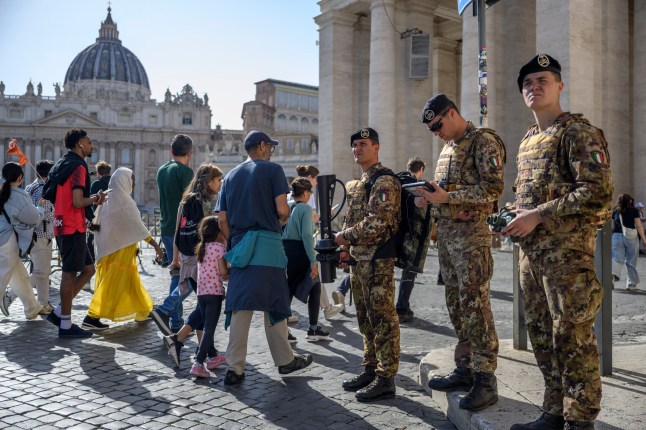
A top-level security operation is underway in Rome as Italy prepares for the funeral of Pope Francis, with an elite and secretive military unit assigned to watch the skies for aerial threats.
The unnamed group, known for its expertise in drone warfare, will oversee airspace above the Vatican and wider Rome during the final journey of the late pontiff.
As thousands of mourners and global leaders prepare to gather in St Peter’s Square, authorities are rolling out one of the most extensive security plans in recent Vatican memory. Though the Italian government has not officially declared a heightened threat status, officials are treating the funeral as a high-risk event, with multiple layers of security now in place.
Among the new measures is the full closure of Roman and Vatican airspace. This includes a ban on all commercial and private flights, as well as the strict monitoring of drone activity. The military unit assigned to the operation, whose identity remains classified, is typically deployed in conflict zones and trained to detect and neutralize unmanned aerial threats.
Beyond aerial surveillance, security officials will be keeping a close watch on the River Tiber, which runs through the heart of Rome, and managing large crowds expected in pilgrimage sites and public spaces. The timing of the pope’s death—on Easter Monday—has added to the complexity of the security challenge, as the city is already flooded with tourists.
In a historic departure from Vatican tradition, Pope Francis will not be buried beneath St Peter’s Basilica. Instead, his body will be taken to the Basilica of Santa Maria Maggiore on Esquiline Hill, not far from Rome’s central train station. This unusual route has expanded the security footprint of the operation, requiring coordination across different branches of the Italian security forces.
Franco Fantozzi, a former high-ranking officer in Italy’s Carabinieri and now a senior security consultant, said authorities are not taking any chances. Although he declined to name the drone unit, he confirmed their presence and their task of scanning the skies for any sign of trouble.
In preparation for the funeral, thousands of security personnel—uniformed and plainclothes—are already on the ground. Roads near the Vatican are heavily monitored, with many intersections under constant watch. Traffic has become severely congested as police cordon off areas and inspect vehicles.
While there is no known specific threat, recent years have taught Italian authorities to stay alert. The current threat level in Italy is officially rated as medium to high, or Level 2. Previous papal funerals have gone without incident, but with Pope Francis’s global influence and the symbolic weight of his final journey, authorities are treating this farewell as an event of utmost importance.
The funeral, expected to draw millions around the world, will be not only a solemn religious moment but also a major test of Italy’s ability to secure one of the most visited cities in the world during a time of deep emotion and transition.