
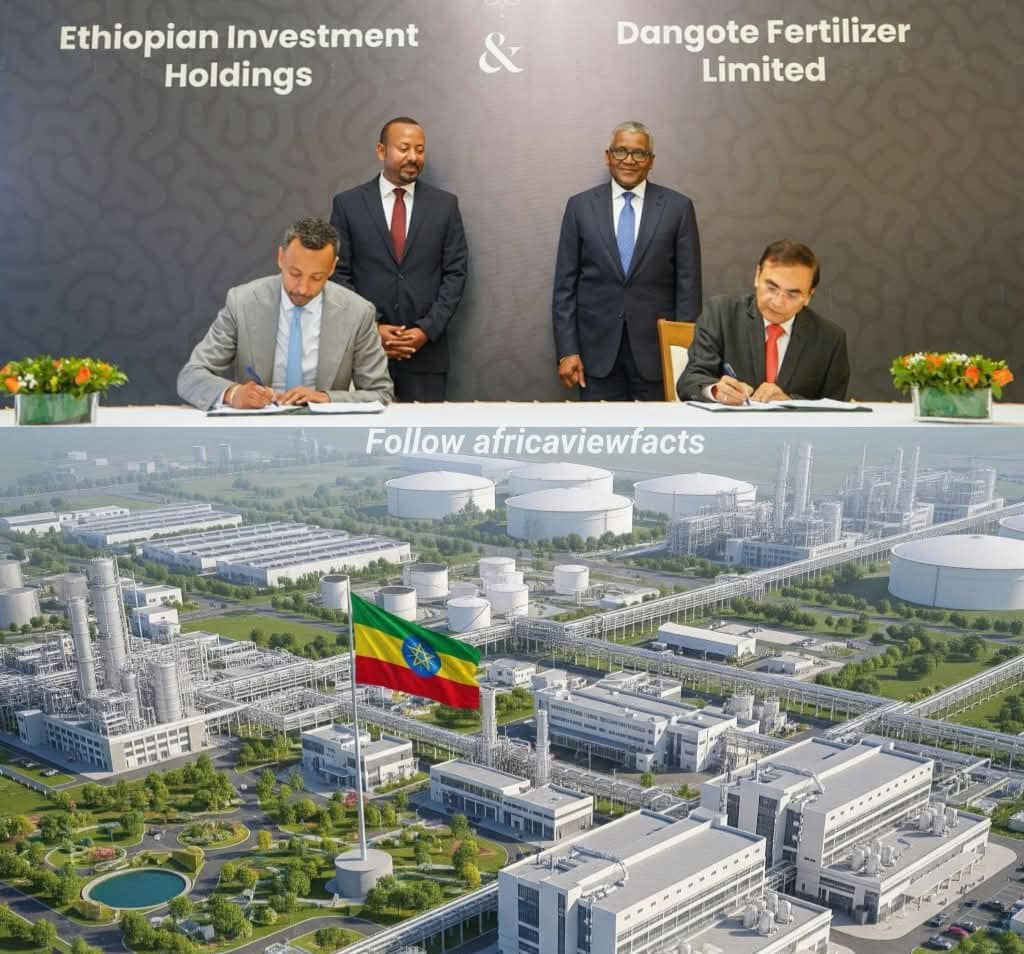
Ethiopia has signed a landmark $2.5 billion agreement with Nigeria’s Dangote Group to construct a urea fertilizer plant, poised to make the country one of the world’s largest fertilizer producers. The facility, located in Gode, Ethiopia, will have an annual production capacity of up to 3 million metric tons.
“This partnership with Ethiopian Investment Holdings represents a pivotal moment in our shared vision to industrialize Africa and achieve food security across the continent,” said Aliko Dangote, President of Dangote Group. “We are committed to bringing our decades of experience in large-scale industrial projects to ensure this venture becomes a cornerstone of Ethiopia’s industrial transformation and a catalyst for agricultural productivity throughout the region.”
The project is expected to significantly reduce Ethiopia’s dependence on fertilizer imports, boost crop yields for the over 70% of the population employed in agriculture, and create thousands of direct and indirect jobs. Dr. Brook Taye, CEO of Ethiopian Investment Holdings, emphasized that the project aligns perfectly with Ethiopia’s national development priorities, enhancing agricultural productivity and positioning the country as a regional hub for fertilizer production.
“The utilization of our domestic Hilal and Calub gas reserves through dedicated pipeline infrastructure ensures energy security and cost competitiveness for decades to come. We are confident that this partnership will deliver tremendous value to Ethiopian farmers, contribute to food security, and generate substantial economic benefits for our nation,” Dangote added.
The plant will be linked to the Hilal and Calub natural gas fields via a dedicated pipeline, ensuring a reliable and cost-effective feedstock supply. With a 60-40 partnership structure, Dangote Group will hold a 60% stake, while Ethiopian Investment Holdings will retain 40%. The project is expected to be completed within 40 months ¹ ².
Ethiopian Prime Minister Abiy Ahmed hailed the agreement, describing it as a decisive step toward food sovereignty. “This project will create jobs locally, ensure a reliable fertilizer supply for our farmers who have long faced challenges, and mark a decisive step in our path to food sovereignty,” he stated.