
By Sunday Abah, Abuja
The Federal Capital Territory (FCT) Commissioner of Police (CP) Ajao Saka Adewale, has called on Nigerian journalists to play a more active role in exposing and curbing illegal mining activities, describing the menace as a grave threat to national security, the economy, and the environment.
Speaking at a media parley organised by the Nigeria Union of Journalists (NUJ) in Abuja on Wednesday, the commissioner warned that illegal mining is more than just an economic crime, stressing that it fuels insecurity, degrades the environment, displaces communities, and undermines legitimate investments.
Quoting data from the Nigeria Extractive Industries Transparency Initiative (NEITI), he lamented that Nigeria loses an estimated $9 billion (₦13.7 trillion) annually to illegal mining and gold smuggling.
“This massive fiscal leakage drains our foreign exchange, erodes tax revenues, and robs the country of resources needed for development,” he said.
On the security front, the commissioner noted that illegal mining had been directly linked to violent crimes such as banditry, kidnapping, and armed conflict, especially in Zamfara, Katsina, Niger, and parts of the Federal Capital Territory (FCT).
He explained that the scramble for control of mineral-rich sites has emboldened criminal cartels, with powerful individuals allegedly financing operations while using foreigners as fronts.
“Illegal mining in Nigeria has cartel-like features. These networks coordinate extraction, smuggling, and financing of terrorism. Sadly, some well-connected Nigerians are the true drivers of this menace, while artisanal miners are only pawns,” he added.
He listed major illegal mining hotspots in Zamfara (gold), Nasarawa (lithium), Kogi, Kaduna, Niger, Kwara, and Osun states. Within the FCT, he said security agencies had made several arrests in Gwagwalada, Asokoro, Gaube, Kuje, and Katampe Extension, with 72 suspects apprehended between 2023 and 2024. He commended the FCT Minister, Chief Nyesom Wike, for ordering a comprehensive clampdown on the illicit trade.
Highlighting the critical role of the media, the commissioner urged journalists to:
build grassroots tip networks around mining communities; share verifiable intelligence such as photographs, coordinates, and vehicle details with security agencies; track and expose shell companies and illicit export chains through investigative reporting; educate the public on the environmental, health, and social dangers of illegal mining; and conduct risk assessments and collaborate with law enforcement when reporting from volatile areas.
He stressed that defeating illegal mining requires strong collaboration between security agencies and the press.
“In conclusion, illegal mining robs Nigeria of its wealth, fuels insecurity, and empowers criminal cartels. But with the resolve of our security agencies and the vigilance of the media, this menace can be defeated. Together, through enforcement, intelligence, and enlightenment, we can protect our resources and secure a safer, more prosperous Nigeria,” he said.
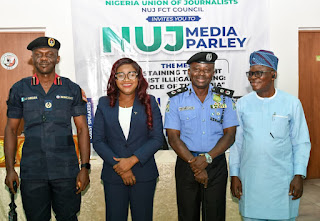
Dignitries at the media parley were the Commissioner of Police FCT (CP) Ajao Saka Adewale, Commandant, Mining Marshal Attah John Onoja, and the National President Miners Association Dele Ayanleke, Members of the Nigeria Union of Journalists, and other stakeholders
In the same vein, the NUJ FCT Council Chairman, Miss Grace Ike, called on journalists across the country to take a more proactive role in exposing and combating the menace of illegal mining which she described as a “grave national concern” threatening Nigeria’s environment, economy, and security.
According to her, illegal mining goes beyond environmental degradation, as it endangers lives, undermines sustainable economic development, and fuels insecurity in different parts of Nigeria.
She stressed that tackling the challenge requires collaboration among stakeholders, including the media, security agencies, government regulators, and civil society.
“As gatekeepers of truth and agents of accountability, our duty as journalists goes beyond mere reportage. We must investigate, expose, and educate the public on the devastating effects of illegal mining, particularly on communities and water resources,” she stated.
The NUJ FCT Chairman noted that balanced and accurate reporting can highlight the hidden dangers and human costs of illegal mining, while also pressing policymakers to take decisive action.
He further assured that the NUJ FCT Council would continue to amplify the voices of affected communities to ensure their concerns are addressed.
“Empowering citizens with information gives them the tools to demand better regulatory oversight and environmental protection,” he added.