
By SUNDAY ABBA, Abuja
The Federal Government of Nigeria (FGN) has reaffirmed its commitment to the implementation of the roadmap for the development of the energy transitions and critical minerals (ETCMs) value chain in Nigeria.
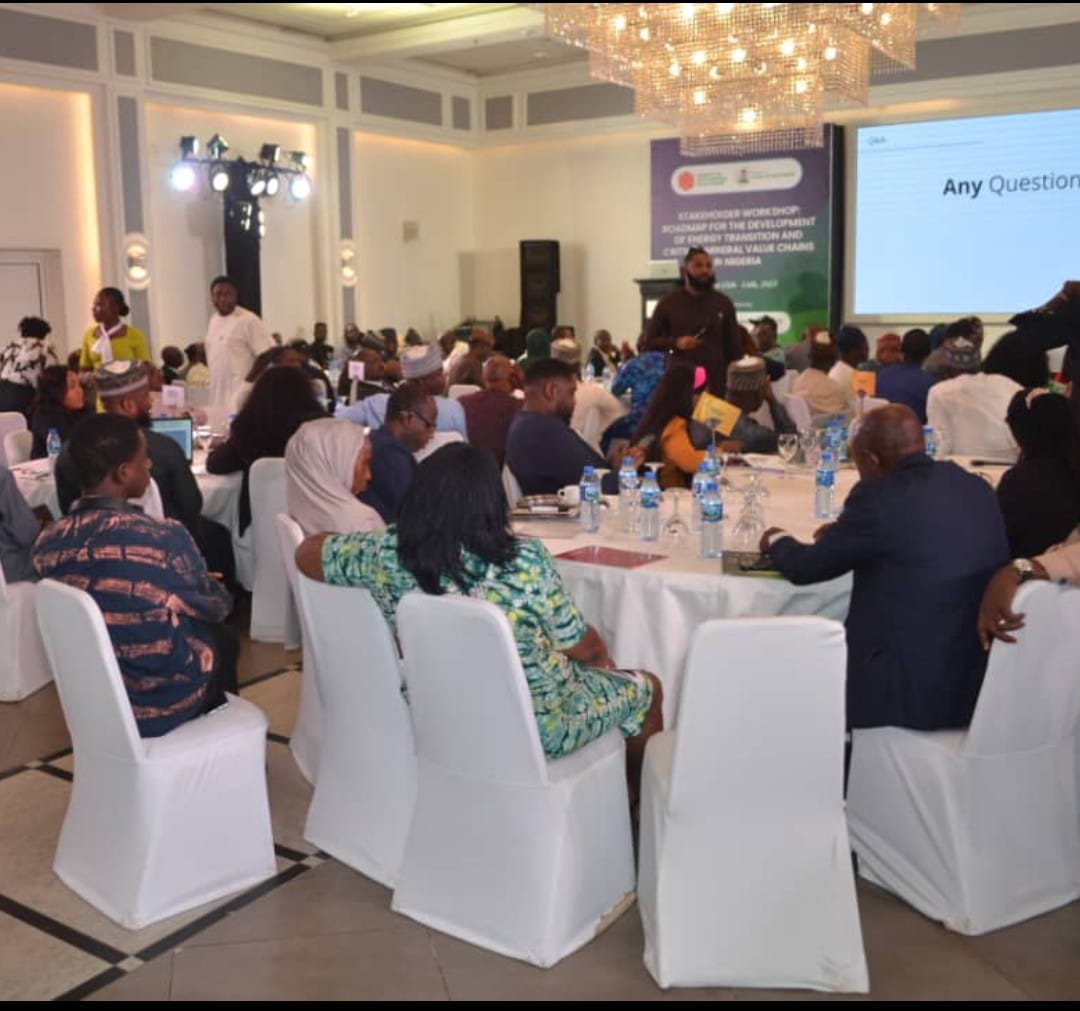
This was stated by Minister of Solid Minerals Development Dr Dele Alake in Abuja while declaring open a two-day Stakeholder Workshop on the implementation of the Roadmap for the development of ETCMs value chain in Nigeria.
According to a statement signed by Kania Maliki Andeyaba, head, Press and Public Relations Department, Dr Alake who was represented by the Permanent Secretary (PS) in the ministry, Engr Faruk Yusuf Yabo, said: “Today’s gathering is not just any other technical meeting. It is a strategic milestone in our journey to harnessing the immense potential of our mineral resources at a sustainable level, driving industrialisation, and positioning Nigeria as a key player in the global energy position.
“As we go around the world, the demand for these rare earth elements and other critical inputs for energy transition keeps mounting. Technology is moving at an unprecedented pace. These are the backbones for solar panels, wind turbines, electric vehicles, and their storage systems and, of course, other local technologies.
“Nigeria is blessed with abundant deposits of these minerals, and our mining sector remains underexposed and largely underdeveloped.”
Speaking further, he said the “roadmap we are incorporating today is aimed to change this by attracting investment and, of course, moving the critical and energy transition mineral (Cvalue chain from exploration to utilisation; building energy infrastructure and human capital; strengthening governance, security, environmental compliance, and stewardship; supporting artisanal and small-scale miners while promoting industrial scale operations; and ensuring that mining benefits flow equitably to our communities and contribute to a broader environment across federal, state, and local governments.
“This workshop is therefore unique because we are adopting a collaborative approach to policy making. In other words, we are today incorporating this particular roadmap, and by doing that, we bring together governments, industries, communities, academia, and, of course, our development partners towards shaping the shared vision”.
Alake further noted that the roadmap will complement the ministry’s seven-point agenda as well as which goes as far as aligning its continental framework such as the African rare mineral strategy and African mining vision thereby ensuring that Nigeria’s voice is strong at regional and global forums.
He said, “On this note, I therefore urge all participants to be open-minded, forward-looking, and practical in our contributions during discussions. Let us identify not just challenges but concrete actionable steps that will enable Nigeria to be competitive around these incorporated value chains towards job creation, industrial linkages,attracting investment, and supporting our commitment to the low-carbon future”
A paper presented by Engr Obadiah Nkom, Director General, Nigeria Mining Cadastre Office (MCO) titled: Implementation of the 2016 Nigerian RoadMap, Overview of the Mineral Sector dwelt on the historical backgrounds, challenges of sector prior to 2016 Roadmap, overview of the 2016 RoadMap and status of implementation of the 2016 Roadmap.
According to Engr.Nkom, the historical background of the Nigerian mining sector dates back to 1902 when colonial masters commenced organised mining activities.
He said that 1905 marked the establishment of mining surveys, as the first mineral was classified by Royal Niger Company.
“1906 marks the commencement of coal exploration and mining, 1914 marks the discovery of other minerals in commercial quantity, and the second the second mineral mined in commercial quantity was gold in Niger and Kogi States respectively.
“By 1919, there was an establishment of Geological Survey as a department. In 1946, the Mineral Ordinance was constituted. In 1950, coal ordinance resulted in the establishment of Nigeria Coal Corporation by government.
“By 1964, the explosive act was constituted. This continued up to 2024, which brought about Nigerian Mineral Value Chain Regulations.”
Engr Nkom stated that the challenges of the sector prior to 2016 roadmap included: poor policy initiatives, inadequate geoscience data generation, industry tilted to small-scale miners, limited stakeholders leverage.
He highlighted some of the objectives of the roadmap to include economic diversification; attracting investment and creating jobs; and sustainable resource management.
According to Nkom, the roadmap implementation time frames were categorised as immediate- Initiative that need to begin right away (June 2016), short-term initiative, – between the first 6 months and 2 years of the plan, dovetailing into long-term Initiative-between years 5 and 10 of the plan;
ongoing initiative:- one that span the lifetime of the plan and may be revisited.
He noted that the value addition policy has resulted in the inauguration of a 100 million dollar lithium battery plant (Avatar Energy) in Nasarawa in May 2024, with a daily capacity of 4,000 tonnes, expected to create 4,000 jobs.
According to him, value addition also resulted in a 600 million dollar lithium plant near the Kaduna-Niger border (to be commissioned shortly) and a 200 million dollar refinery on Abuja outskirts that are in advanced stages. Further to this, NASENI and Rural Electrification Agency (REA) signed a 150 million dollar deal in 2023 to build a lithium-ion battery manufacturing and processing factory.
Also, the World Bank, in its presentations at the workshop, stressed the surging global demand for ETCMs . It further stated that the energy transition could increase demand for minerals like lithium, cobalt, and rare earth elements by up to 500% by 2050.
The presentation also stressed on Nigeria’s significant potential in ETCMs, noting that Nigeria holds confirmed reserves of lithium, tin, niobium, tantalum, manganese, iron ore, and lead/zinc.
It further disclosed that lithium is found across Nasarawa, Kwara, Kogi, and Ekiti States.
According to the World Bank, on account of the strategic urgency amid global supply chain realignment, countries are restoring supply chains and enacting policies like the EU Critical Raw Materials Act- narrowing the window for Nigeria to secure its place in global ETCM value chains, and on alignment with national industrial policy goals, the ETCMs support the objectives.
The workshop later went into breakout sessions for more technical deliberations and discussions as well as presentations of their conclusions.
It has in attendance director generals, and CEOs of the Nigerian Solid Mineral Sector, and directors from other MDAs, representatives of states and local governments, development partners particularly the representatives of the world Bank and their partners, industry leaders, members of the academia, and representatives of mining communities.