
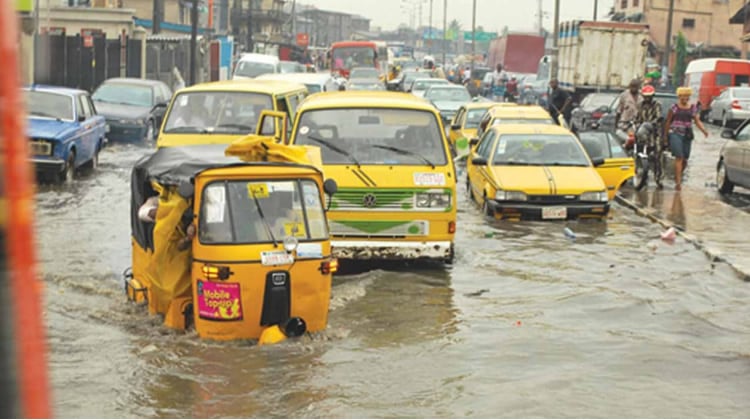
Heavy rainfall on Wednesday led to widespread flooding across several parts of Lagos State, leaving motorists stranded and disrupting normal activities.
The downpour caused severe gridlock as vehicles struggled to pass through waterlogged roads, while residents and business owners faced losses as floodwater entered their homes, shops, and places of worship.
The areas most affected included Maryland, Lekki, Ogba, and Ikorodu, where streets were submerged after hours of rain. In Maryland, an overflowed canal cut off access to nearby communities, forcing residents to wade through floodwater or remain indoors. In Ogba and its surroundings, traffic became almost impossible as junctions and major roads were submerged, causing vehicles to break down on the flooded routes.
Residents described how the flood spread quickly into houses and shops, destroying property and forcing some people to evacuate. Some worship centres were also affected, with water damaging equipment and making the buildings unfit for use. Business owners reported losses as goods and furniture were soaked, while commuters shared how they spent long hours in traffic, with some opting to sleep in their offices due to the inability to get home when it rained.
The situation was not different in Lekki and Ikorodu, where videos circulating online showed entire streets under water. Many residents were seen scooping water out of their houses, while motorists attempted to drive slowly through the submerged roads. Some cars broke down, adding to the already difficult movement.
Flooding in Lagos has long been a recurring issue, with properties and goods worth millions lost every year. The problem also affects health and safety, as stagnant water after heavy rains often leads to the spread of waterborne diseases.
In response to the latest incident, the Lagos State Government acknowledged the damage and assured residents that efforts were ongoing to reduce the impact of flooding. The Commissioner for the Environment and Water Resources, Tokunbo Wahab, explained that the state’s position as a coastal city makes it prone to such events, especially during heavy rainfall. He noted that drainage systems are being expanded, and canals are being cleared to allow water to flow freely.
Wahab pointed out that in some areas like Lekki, the flooding was worsened by drainage challenges and poor construction practices. He added that illegal structures and refuse dumped in drains also contributed to the situation, stressing that such obstructions will be removed. The government also announced that pumping stations are being planned in certain communities to ease water flow during heavy rains.
While the government promised to continue improving drainage systems, it urged residents to play their part by avoiding dumping waste in drains and refraining from building on floodplains. The ministry said the water levels had gone down by Thursday morning, but preventive measures are still needed to keep Lagos safer during the rainy season.