
Grid Collapse In Nigeria: NERC, Others Call For Proactiveness, Inclusivity, Innovation
By SUNDAY ABBA, Abuja
The Nigerian Electricity Regulatory | Commission (NERC) has urged operators along the electricity value chain to be proactive, even as it pledges support to end the menace of incessant grid failure experienced in recent times.
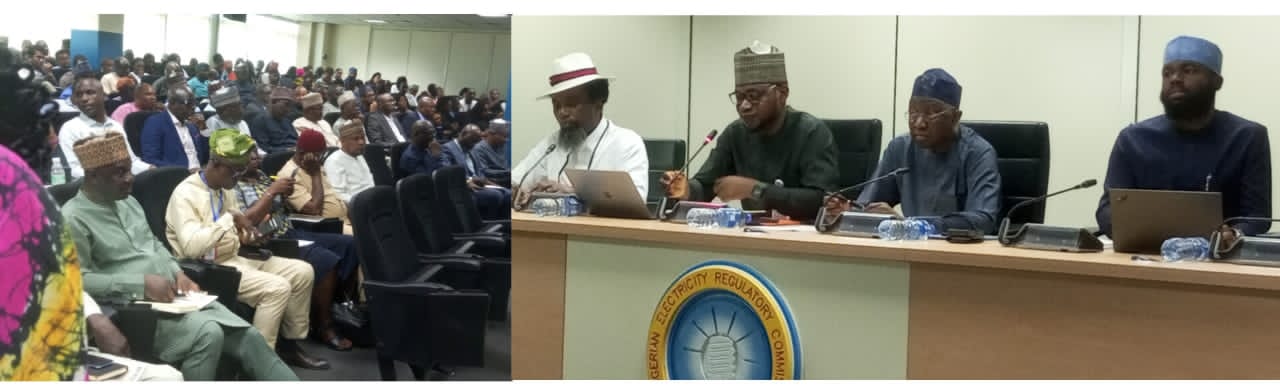
NERC Chairman/CEO Engr Sanusi Garba gave the charge during a public hearing held at the commission’s headquarters on Thursday in Abuja which brought together stakeholders to address the issues surrounding the recurring grid disturbance that has in recent times thrown the nation into darkness intermittently.
This is coming on the heels of the latest grid disturbance of Monday, 14 October, 2024 that led to power outage in the Northern parts of the country, less than a week of two similar incidents that happened in other parts in quick succession.
Describing the situation as a national embarrassment that must stop, the NERC boss, alongside other commissioners seated at the event, noted that the ugly situation had prevailed because the operators, especially the Transmission Company of Nigeria (TCN), being the primary custodian and manager of the grid, were not being proactive and collaborative enough.
He thanked the stakeholders for their contributions to the public hearing, assuring that all their submissions would be reviewed and actioned appropriately after a careful consideration by the commission to ensure grid collapse or disturbance as the case may be becomes a thing of the past in the country.
“Of course we are also very much passionate about identifying short term and middle term actions that we need to take following the hearing today, and also the submissions that we will be receiving even after the hearing.
“Clearly, the issue of maintenance culture has been repeated and repeated by many of the participants here, and of course within TCN itself, but we did, from our intervention, expressed our concern about TCN not optimising its own utilisation of scarce resources.
“So we will look at the PIP (Performance Improvement Plans) again and make sure that some of the urgent steps that we need to take are taken to make sure that this issue of system collapse, a national embarrassment, is a story of the past,” Garba said.
According to a yearly partial and total grid collapses chart in a presentation made on behalf of the Transmission Company of Nigeria (TCN) by Engr Nafisat Ali, Executive Director (ED), System Operation (SO) to kickstart the event, the grid has recorded a total of 6 collapses, partial 4, total, 2, of which 4 were as a result of generation issues, and 2, due to system equipment failures.
Ali who is also the head of the forensic investigative committee on grid collapses in Nigeria which was set up by the Minister of power, Adebayo Adelabu, advised that the challenges in the value chain be holistically addressed to resolve the crisis, adding that cooperation of all stakeholders is a must if the largely manually operated grid must make headway.
Speaking for the generation companies (GenCos), Executive Secretary/ CEO of the Association of Power Generation Companies (APGC), Dr Joy Ogaji, noted that the incidence of grid disturbance occurs at a more alarming rate than the figures presented to the public.
She said the country recorded 162 cases of grid collapse from 2013 till date, with the attendant huge financial loss by individuals and corporate bodies as well as government.
According to her, the solution does not lie squarely on the free governor and spinning reserve being canvassed for, but also on observance of operational ethics and discipline by all players.
She disclosed that the association did a study and found out that 95 per cent of the time, from 2013 till date, a the grid has not been in compliance with the grid code requirement of 50 4 hertz.
“It has always been out of frequency requirement of the grid,” she revealed, urging transparency and seamless operational collaboration to change the narrative.
In their respective submissions, the stakeholders, comprising representatives of the TCN, generation and distribution companies, professional bodies, civil society groups (CSO), media, interveners from the private sector, were unanimous on the need to adopt a holistic approach to innovative maintenance culture, system upgrade and replacement of obsolete equipment, as well as transition to a smart grid.
Engineering knowledge gap in the industry was highlighted, especially in TCN, and the stakeholders agreed that reengineering it by way of capacity building must be prioritised to achieve the desired change.
An intervener, Mallam Imamudeen Talba, former senior staff of NERC and former board member of TCN, in his submission, said TCN should not be singled out as the weakest link in the market because the company is not independent as, according to him, it is held captive to the Ministry of Power and the political class who usually force it into projects outside its scope.
This is as some stakeholders advocated for private investments in the transmission company.
In recent years, the Nigerian power sector has witnessed an alarming surge in challenges, including but not limited to poor governance, gas and transmission system constraints, as well as significant shortfall in power supply and revenue, barring the initial tall expectation among stakeholders after the upstream and the downstream of the industry was privatised in November 2013 as a way forward to incremental and stable quality power supply in the country.