
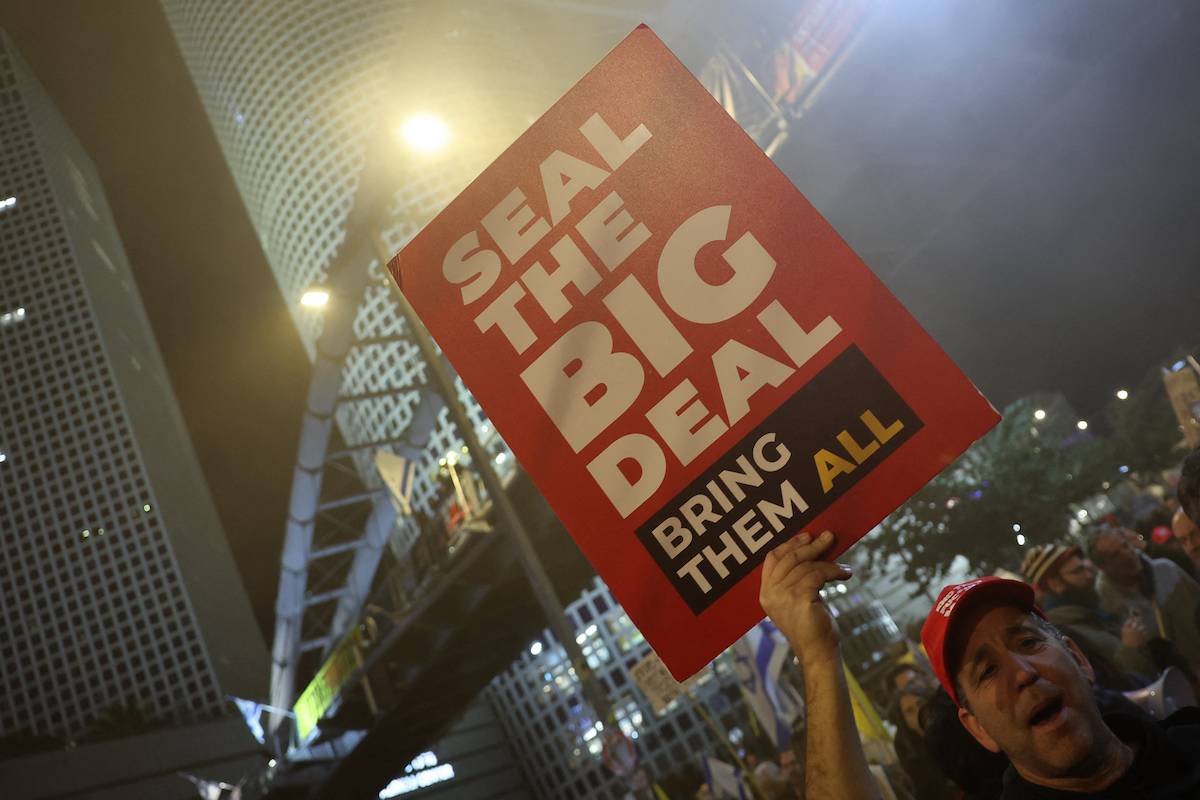
Hamas is prepared to release all remaining Israeli hostages immediately if Israel agrees to end its military campaign in Gaza and withdraw its forces, a senior Palestinian official involved in ongoing truce talks told The Times of Israel.
The official said Hamas is ready to proceed with the full release under the condition of a permanent ceasefire — a key part of the second phase in a deal brokered in January.
The second phase of the agreement, scheduled to begin on March 2, was supposed to bring a complete halt to hostilities and a full Israeli withdrawal from Gaza. However, the official accused Israel of refusing to honor that part of the deal. Instead, Israel has reportedly pushed for an extension of the first phase, which only allowed short ceasefires and partial prisoner swaps.
The source claims Israel is trying to continue military operations while negotiating for the hostages without meeting the full terms agreed earlier. He also stated that Israel’s refusal to move forward with phase two amounts to a breach of the original deal, which Israel had signed.
Israeli Prime Minister Benjamin Netanyahu has repeatedly rejected any agreement that would allow Hamas to remain in control of Gaza. He has also avoided entering phase two negotiations, which were supposed to begin in early February.
The official said Hamas is not demanding to remain in power. He said the group is open to transferring authority in Gaza to a neutral Palestinian-led body and accepting a long-term truce with security guarantees. However, he stressed that Hamas would not disarm unless a sovereign Palestinian state is established, arguing that the group’s armed role is central to its identity as a resistance movement.
The official also pointed to what he described as inconsistent US involvement in negotiations. According to him, American hostage envoy Adam Boehler had engaged in direct talks with Hamas earlier this year, but those were cut off by White House advisor Gabe Witkoff after news of the talks became public.
He questioned how a resolution could be reached without direct communication, citing past US negotiations with groups like the Taliban as a precedent.
A recent Reuters report supports many of these claims, noting that Hamas has rejected Israel’s latest proposal and continues to stand by the original deal brokered by Egypt and Qatar. That deal included a 50-day ceasefire, the release of hostages beginning with American-Israeli soldier Edan Alexander, a prisoner swap of 250 Palestinians for each Israeli, and a complete suspension of Israeli military activity during the truce. It also called for humanitarian aid corridors to be reopened, including the Netzarim route.
Meanwhile, the Israeli military campaign in Gaza presses on. According to local health authorities, more than 50,000 Palestinians have died since the conflict escalated. The destruction across the enclave is vast, and Israel now faces genocide accusations at the International Court of Justice.
Despite the worsening situation, the Palestinian official said Hamas’s position remains consistent. He stated that if Israel commits to ending the war and withdrawing, Hamas will release all hostages in return.