
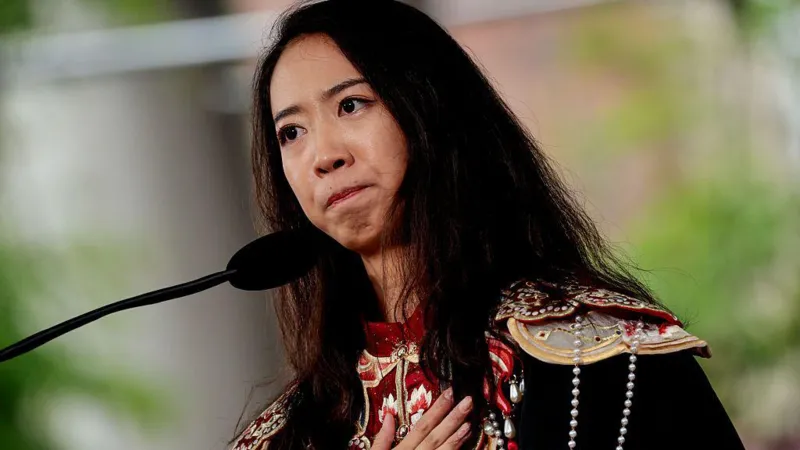
A Chinese student’s graduation speech at Harvard has triggered both admiration and backlash, drawing attention on both sides of the world.
Jiang Yurong, who graduated with a degree in international development, delivered her address at a time when tensions between the US and China are running high, particularly over student visa policies.
The moment came just as a federal judge in the US blocked an attempt by the Trump administration to ban foreign students at Harvard. The same day, Jiang took the stage as the first Chinese woman to speak at a Harvard graduation. Her speech focused on finding common ground in a fractured world. She talked about the value of learning in classrooms full of people from different cultures and shared how her experience taught her to understand others’ lives deeply, not just academically but emotionally.
Jiang’s words were met with emotional responses on Chinese social media. Many said her message brought them to tears and expressed pride in seeing a Chinese voice represented on such a prestigious stage. However, some felt she did not reflect the struggles of ordinary Chinese students, pointing to her elite education path and international background. Questions about her family’s connections also surfaced, with online discussions suggesting her father’s involvement in organizations with political or foreign ties.
In the US, Jiang’s speech did not go unnoticed by conservative commentators. One high-profile X account accused Harvard of allowing someone with alleged links to Chinese state-backed organizations to speak at its graduation. The account, which has a large following and a history of posting political content supportive of Donald Trump, raised concerns over Jiang’s father’s work and hinted at influence from the Chinese Communist Party.
Back in China, others dismissed these claims as politically driven. Some users argued that the organizations involved have ties to American companies and foundations as well, casting doubt on the narrative that Jiang’s success was the product of political connections.
Reactions online were mixed. Some called on her to remain in the US, often in sarcastic tones, suggesting that talents like hers should be kept abroad. Others rallied behind her, saying that her ability to speak openly and thoughtfully reflected the potential of Chinese students to contribute to global dialogue.
Jiang’s background is international. She finished high school at Cardiff Sixth Form College in Wales and later earned her undergraduate degree from Duke University in the US. Her Harvard journey adds to a growing number of international students who now make up over a quarter of the university’s student body. Among them, Chinese students represent the largest group, followed closely by Indian students.
Her message, centered on shared humanity and rejecting division, has sparked debate, but it has also brought attention to the complex experience of Chinese students abroad. In a world increasingly shaped by political rivalry, Jiang’s story has opened up fresh conversations about identity, belonging, and the power of student voices on the global stage.