
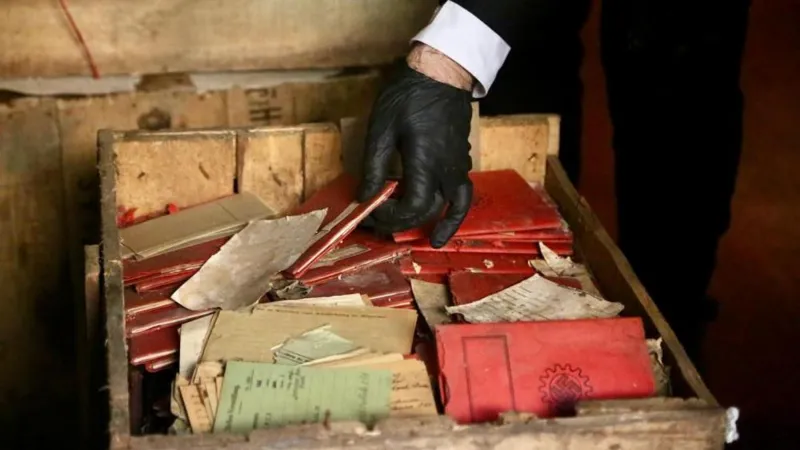
A long-forgotten collection of Nazi-era documents has come to light in the basement of Argentina’s Supreme Court, surprising workers who were preparing the area for the court’s archive to be moved to a museum.
The wooden crates, first believed to be discarded storage, were opened to reveal materials linked to Adolf Hitler’s regime, including membership booklets and propaganda from the 1940s.
The crates were originally sent from the German embassy in Tokyo and arrived in Argentina on June 20, 1941, aboard a Japanese steamship named Nan-a-Maru. The shipment included 83 sealed diplomatic pouches labeled as personal belongings. However, Argentine customs agents at the time grew suspicious of the volume and chose to inspect five of the pouches. What they found were Nazi materials — propaganda, postcards, and photos — which triggered a deeper investigation.
Court records show that the entire shipment was then confiscated by Argentine authorities. The German embassy in Buenos Aires reportedly tried to recover the documents by asking that they be returned to Tokyo. Instead, in September 1941, an Argentine judge ordered all 83 pouches to be seized permanently. The Supreme Court was responsible for deciding what to do with the materials, but with no final decision made, they were left untouched.
The documents remained hidden for decades until workers recently found the crates during a cleanup operation. Inside were printed materials with swastikas, black-and-white photographs, and detailed records that appeared to belong to Nazi-affiliated organizations. The court quickly secured the crates and contacted the Buenos Aires Holocaust Museum, which is now helping create a detailed inventory of the contents.
Historians believe these documents could provide fresh insight into Nazi financial operations and global connections, especially regarding South America’s role during and after World War Two. Argentina maintained a neutral stance for most of the war but later cut ties with the Axis powers in 1944. Despite this, the country became a haven for some top Nazi fugitives after the war, including notorious figures like Adolf Eichmann and Josef Mengele.
The rediscovery of these documents revives attention to a dark chapter in Argentina’s past. In 2000, the nation formally acknowledged and apologized for sheltering Nazi war criminals. Now, experts hope the forgotten files will help fill in missing pieces of history and uncover more about the Nazi regime’s global influence.