
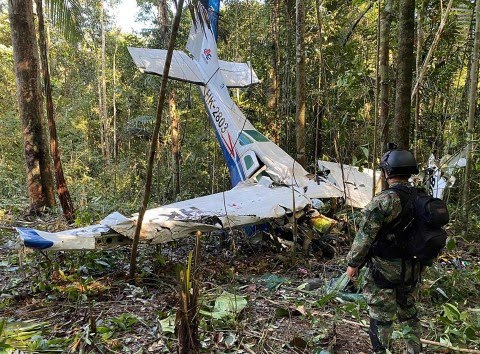
A Cessna 206 light aircraft had been taking four children and their mother from their home near Araracuara, in southern Colombia, to San José del Guaviare. But then the engine failed, and it nosedived deep into the Amazon rainforest on May 1, 2023.
When rescuers eventually found the plane two weeks later, three bodies were found: the children’s mother, Magdalena Mucutuy, 33, pilot Hernando Murcia Morales and local indigenous leader Hermán Mendoza Hernández.
At the crash site, soldiers found a baby’s bottle and some wild passion fruit bearing human bite marks. Suitcases had been rummaged through, suggesting eldest sibling Lesly, 13, had taken what she needed to lead Soleiny, 9, Tien Noriel, 4, and Cristin Neriman, 11 months, into the jungle.
In the two weeks that had passed, the children could have walked miles from the plane, and with their whereabouts unknown, a massive search operation was launched, led by the Colombian military and supported by local indigenous volunteers.
It wasn’t a straightforward mission; it was the first time the military and indigenous groups had worked together on an official mission after 50 years of internal conflict.
According to survival expert Dave Connell, who has extensive knowledge of rainforests from expeditions in Laos, Thailand, Borneo and Papua New Guinea, it was also far from an easy environment to search.
The area is huge and inhospitable; a dense, uncharted jungle three times the size Bogota, where soldiers were at risk of attack by FARC dissidents – a rebel guerrilla group that had been at war with the military since the 1960s.
‘The jungle can be an utter nightmare. You can walk all day and only go 500 metres because you have to hack your way through the trees. It’s full of insects, and everything is trying to either bite you or sting you or damage you in some way,’ The former soldier explains.
‘Before you know it, you’ve been bitten by a centipede, or you’ve got a hornet who has implanted a stinger right middle of your forehead. You could find yourself in a river of red fire ants, and then there’s the snakes… it’s a very brutal place.’
There were many threats facing the Mucutuy children, including wild animals, starvation, dehydration, infection and disease. The military wanted to get to them quickly, and every area of command was deployed across the massive area.
They hacked through the thick vegetation with machetes and chainsaws, working alongside the indigenous rescuers, led by Henry Guerro, a local volunteer who, like the children, was Huitoto.