
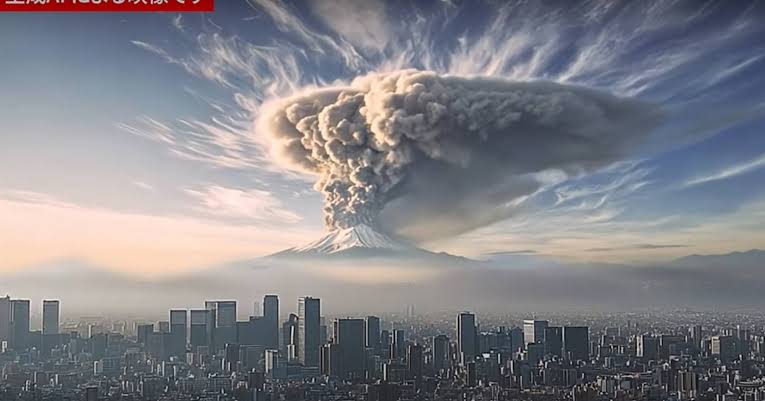
Tokyo authorities have released an AI-generated video illustrating what could happen if Mount Fuji were to erupt, aiming to alert the city’s 20 million residents to potential risks.
While experts say an eruption is not expected soon, Fuji is an active volcano, last erupting in 1707 during the Hoei event.
The video, shared by the Tokyo Metropolitan Government’s Disaster Prevention Division, depicts everyday city life interrupted by an eruption warning on a resident’s phone.
Smoke and volcanic ash are shown spreading from the mountain into Tokyo within hours, creating health hazards and disrupting power, traffic, and food supply.
Alongside the AI video, Japan’s Cabinet Office released a simulation on Volcano Disaster Prevention Day to help citizens visualize specific emergency scenarios.
Japan’s location on the Pacific Ring of Fire makes it prone to earthquakes and volcanic activity, prompting authorities to maintain high awareness campaigns.
Residents have reacted with concern and mixed opinions.
Some worry about the effects on transportation and utilities, while others note the difficulty of preparing for extreme events, especially during Japan’s hot summer months.
Some observers believe such warnings may appear alarmist, potentially discouraging tourists.
Officials have previously advised households near Fuji to keep a two-week supply of essentials.
A large eruption could release 1.7 billion cubic meters of volcanic ash, with nearly 490 million cubic meters accumulating on urban areas, roads, and buildings.
This could cause structural damage to weaker buildings, block transportation, and lead to widespread power outages.
Even a smaller amount of ash can halt trains and make roads impassable if it rains.
Economic estimates suggest a major eruption could cost up to 2.5 trillion yen ($16.6 billion).
Authorities hope that by showing the potential impact visually, residents will take emergency planning more seriously and be better prepared in the event of a natural disaster.