
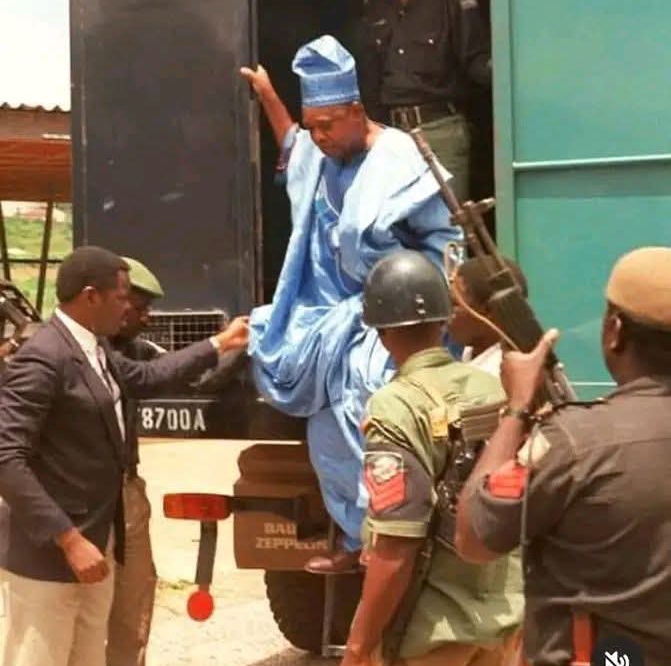
As Nigeria marks another June 12 Democracy Day, the nation must look beyond ceremonial tributes and public holidays. This date, steeped in both triumph and tragedy, should stir a deep national reckoning, a sober reflection on how far we’ve come, and how far we’ve strayed from the ideals that once united a nation behind the ballot.
On that historic day in 1993, millions of Nigerians defied cynicism and fear to cast their votes in what remains arguably the freest and fairest election in our history. Across ethnic, religious, and regional lines, the people stood as one, choosing Chief Moshood Kashimawo Olawale (M.K.O.) Abiola not because of his origin, but because of what he represented: hope, unity, and progress. His campaign, “Hope ’93,” captured the nation’s deepest aspirations—a desire to be governed by vision, not vengeance; by leadership, not looting.
The election was a triumph not only of the ballot but of the human spirit. Under the Option A4 open-ballot system, Nigerians queued publicly behind their candidates in a transparent, orderly process that rendered manipulation nearly impossible. Even under military rule, it was a powerful declaration: the people wanted democracy. But that hope was abruptly extinguished when the military regime annulled the results, plunging the nation into years of repression and betrayal.
Yet, the tragedy of June 12 was not only in the annulment. It is in how, decades later, the virtues that day embodied—transparency, justice, accountability, and the supremacy of the people’s will—remain largely absent from our democratic practice. We now operate a democracy in form, but often not in substance.
Today, Nigeria is no longer under the boots of soldiers, but often the shackles of civilian impunity. The threat to democracy is no longer khaki-clad generals but corrupt institutions, manipulated elections, and a judiciary that has too often traded its gavel for political expediency. The 2023 general elections laid bare this democratic decay.
Despite lofty promises and the deployment of technological innovations like the Bimodal Voter Accreditation System (BVAS) and INEC’s Result Viewing Portal (IReV), the elections were riddled with irregularities, technical failures, and orchestrated violence. In Lagos, a female voter, Jennifer Efedi, was brutally attacked while casting her vote. Her bloodied face became a haunting emblem of the hostility faced by citizens simply trying to participate in democracy.
Across the country, from Rivers to Kogi, voters were intimidated, polling units militarized, and ballot boxes snatched often under the watchful eyes of complicit security operatives. Over 21 lives were reportedly lost to election-related violence. Meanwhile, INEC, the body tasked with safeguarding our democracy, faltered at nearly every turn. The result? A staggering voter turnout of just 27%, despite having over 93 million registered voters.
This was a deafening statement of disillusionment.
In this warped system, elections have become courtroom dramas rather than civic exercises. Judicial verdicts, often shrouded in legalese and technicalities, have overturned clear mandates and imposed rejected candidates.
The growing perception is grim: that electoral outcomes are now crafted by lawyers, not voters; by litigation, not legitimacy. The judiciary, once the last hope of the common man, now stands accused of being a silent partner in democracy’s undoing.
This dangerous drift erodes public trust—not just in elections, but in the very idea of democracy. It feeds a fatalistic belief that votes do not count, that elections are staged rituals, and that the powerful always win. It numbs civic engagement and alienates the citizen from the state.
If June 12 is to mean anything, Nigeria must embark on a democratic rebirth. INEC must be fundamentally overhauled.
As canvassed for by CSOs, NGOs, and professional bodies, appointments to the electoral commission should no longer be the exclusive preserve of the executive. An independent panel—including civil society, the judiciary, and professional bodies—must be empowered to select commissioners based on competence, integrity, and independence.
The BVAS and IReV technologies must not merely be digital accessories, they must work, and work transparently. INEC must run mandatory pre-election testing of its tools, upload results in real time, and hold its officers accountable for lapses.
Electoral offenders, whether ballot-snatchers or INEC officials, must face swift and certain justice.
Our security agencies must remember that their duty is to protect voters, not politicians. Their neutrality is non-negotiable. The presence of police or military personnel at polling units should reassure citizens, not repel them.
The judiciary, for its part, must embark on a thorough house-cleaning exercise urgently to restore eroding glory and public confidence. Judges handling electoral disputes must be above reproach, men and women of transparent honesty and unnegotiable integrity, guided by justice not job offers or political pressures.
The National Judicial Council must be vigilant, proactive, and unapologetic in disciplining errant judges. The people’s mandate must never again be treated as a legal technicality or a precious commodity for the highest bidder.
Political parties, too, must democratize from within. Candidate imposition, godfatherism, and vote-buying have turned parties into personal fiefdoms. If internal democracy is strangled at the primaries, national elections cannot be any better.
We urge the authorities to ensure that there must also be a clampdown on the monetization of politics. Campaign finance laws must be enforced, spending limits respected, and transparency made mandatory. Money should not be the loudest voice in a democracy.
Equally crucial is civic education. Nigerians must be reoriented to understand not just how to vote, but why their vote matters. Schools, media, religious bodies, and civil society must collaborate to rebuild political consciousness. A democracy without informed citizens is a democracy in name only.
We posit that June 12 should no longer be just a date. It is a testament to whether we are willing to honor our history not just with words, but with will. It is a reminder that Nigerians once rose above division and fear to vote for a shared future. That future was stolen, but it need not be lost.
Democracy is not self-executing. It must be defended, deepened, and made to work. The legacy of June 12 demands no less.
Let this day be more than a tribute to a fallen hero. Let it be a promise to ourselves and to generations unborn that we will no longer settle for a democracy that merely survives. We will fight for one that thrives.