
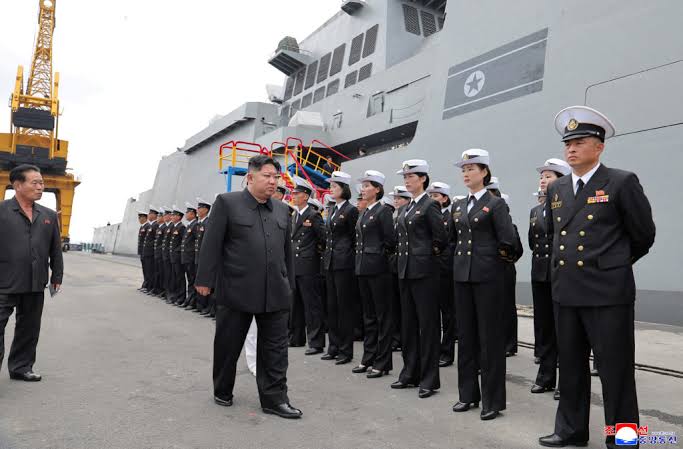
North Korean leader Kim Jong Un has issued strong criticism of ongoing South Korea–U.S. military drills while overseeing his country’s most advanced warship.
During a visit to the port city of Nampo on Monday, Kim pledged to accelerate the growth of North Korea’s nuclear arsenal, citing what he described as hostile maneuvers from Seoul and Washington.
The exercises, known as Ulchi Freedom Shield, began this week and will run for 11 days. They involve 21,000 personnel, including 18,000 South Korean troops, with a combination of field training and computer-simulated operations.
While the allies stress that the drills are defensive in nature, North Korea has long portrayed them as preparations for invasion.
Kim’s inspection centered on the 5,000-ton destroyer Choe Hyon, first unveiled in April. North Korean state media said the ship is being equipped with multiple weapons systems, including air-defense platforms, anti-ship weapons, and nuclear-capable ballistic and cruise missiles.
It is expected to become fully operational next year. During the visit, Kim also checked progress on a second vessel, Kang Kon, which suffered damage during a flawed launch earlier this year, and reviewed preparations for a third destroyer planned for October testing.
North Korea’s leadership has described these naval developments as critical to expanding its range and strike options.
Analysts outside the country remain cautious about the true readiness of the new destroyers, but the regime is presenting them as symbols of modernization and nuclear strength.
Tensions on the Korean Peninsula remain high. The North continues to reject renewed talks on nuclear disarmament, a process that collapsed in 2019 after negotiations between Kim and then U.S. President Donald Trump failed to produce an agreement.
Meanwhile, South Korea’s new president, Lee Jae Myung, has signaled interest in reviving dialogue and restoring a 2018 inter-Korean military pact that was suspended last year amid heightened confrontation.
As both sides hold firm, North Korea is pushing forward with its military agenda, deepening cooperation with Russia, and positioning its navy as a growing pillar of its nuclear strategy.