
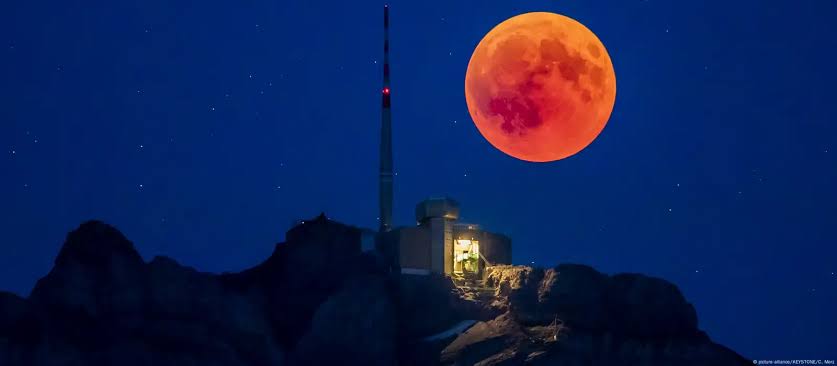
Millions of people across Asia, Europe, Africa, and Australia are preparing to witness the longest total lunar eclipse of the century, a rare celestial event expected to occur on the nights of September 7 and 8.
The astronomical phenomenon, widely referred to as a “Blood Moon,” will last an extraordinary 82 minutes, setting a record for the year 2025.
During the eclipse, Earth’s shadow will completely cover the Moon, causing it to appear deep red in color due to the scattering of sunlight through the planet’s atmosphere.
Astronomers note that such lengthy eclipses are infrequent and provide valuable opportunities for both scientific observation and public engagement with astronomy.
Major observatories and space agencies are preparing to stream the event globally, while amateur stargazers are planning watch parties in regions with clear skies.
The eclipse will be visible to billions of people without the need for telescopes, provided weather conditions allow.
From Africa’s deserts to Europe’s cities and Asia’s coastlines, viewers are expected to turn their attention skyward for a shared global experience.
Cultural and spiritual traditions surrounding lunar eclipses add another layer of significance to the event.
In several regions, the Blood Moon is associated with festivals, rituals, and symbolic interpretations, creating an intersection of science and heritage that deepens its resonance.
Experts are urging people to seize the opportunity, as the next eclipse of similar length will not take place for decades.
With interest spanning continents, the Blood Moon of September 2025 is shaping up to be both a scientific milestone and a collective moment of wonder.