
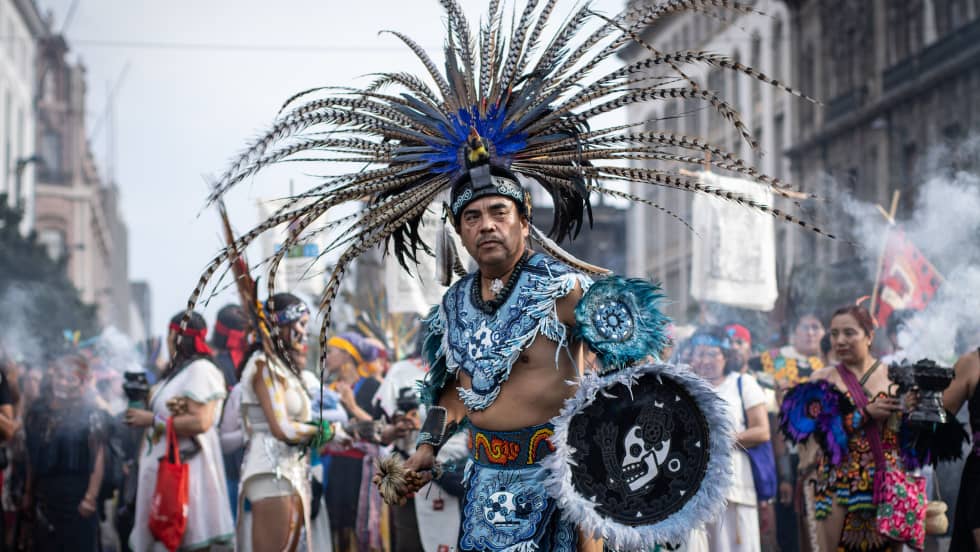
Mexico City held a major celebration marking 700 years since the founding of Tenochtitlan, the capital of the Mexica civilization, which later became modern-day Mexico City.
The festivities took place on Saturday in the city’s main square, featuring performances and traditional ceremonies that honored the region’s Indigenous roots.
Dancers and artists wearing Indigenous clothing reenacted the founding of the ancient city.
Drummers, feathered dancers, and performers with seed-filled ankle rattles took part in sacred dances designed to connect with nature.
These acts were witnessed by top officials and large crowds.
Tenochtitlan, believed to have been founded in 1325, became the heart of the Mexica Empire.
According to early records kept by Spanish chroniclers, the Mexica were guided to settle by a divine sign from their god Huitzilopochtli—an eagle perched on a cactus.
This image later became an important national symbol and appears on Mexico’s current flag.
Today’s events remembered that early civilization, which thrived on an island in a lake surrounded by volcanoes.
Although much of the history was passed down through legend, the origin story of the Mexica tells of their migration from a place called Aztlan.
They arrived in the Valley of Mexico after trying to settle in various other areas.
The lake island where they chose to live was already home to the Tepaneca people. The Mexica were allowed to stay in exchange for payments and labor. Over time, they grew in strength through military skill, trade, and alliances with neighboring peoples.
By the time the Spanish arrived in the 1500s, Tenochtitlan was a large, advanced city filled with canals, markets, temples, and bridges.
Spanish conquistadors described it with amazement. However, the city fell to Spanish forces in 1521, ending the Mexica Empire.
The recent celebration combined cultural memory with civic participation, while also calling attention to the Indigenous heritage that shaped modern Mexico.