
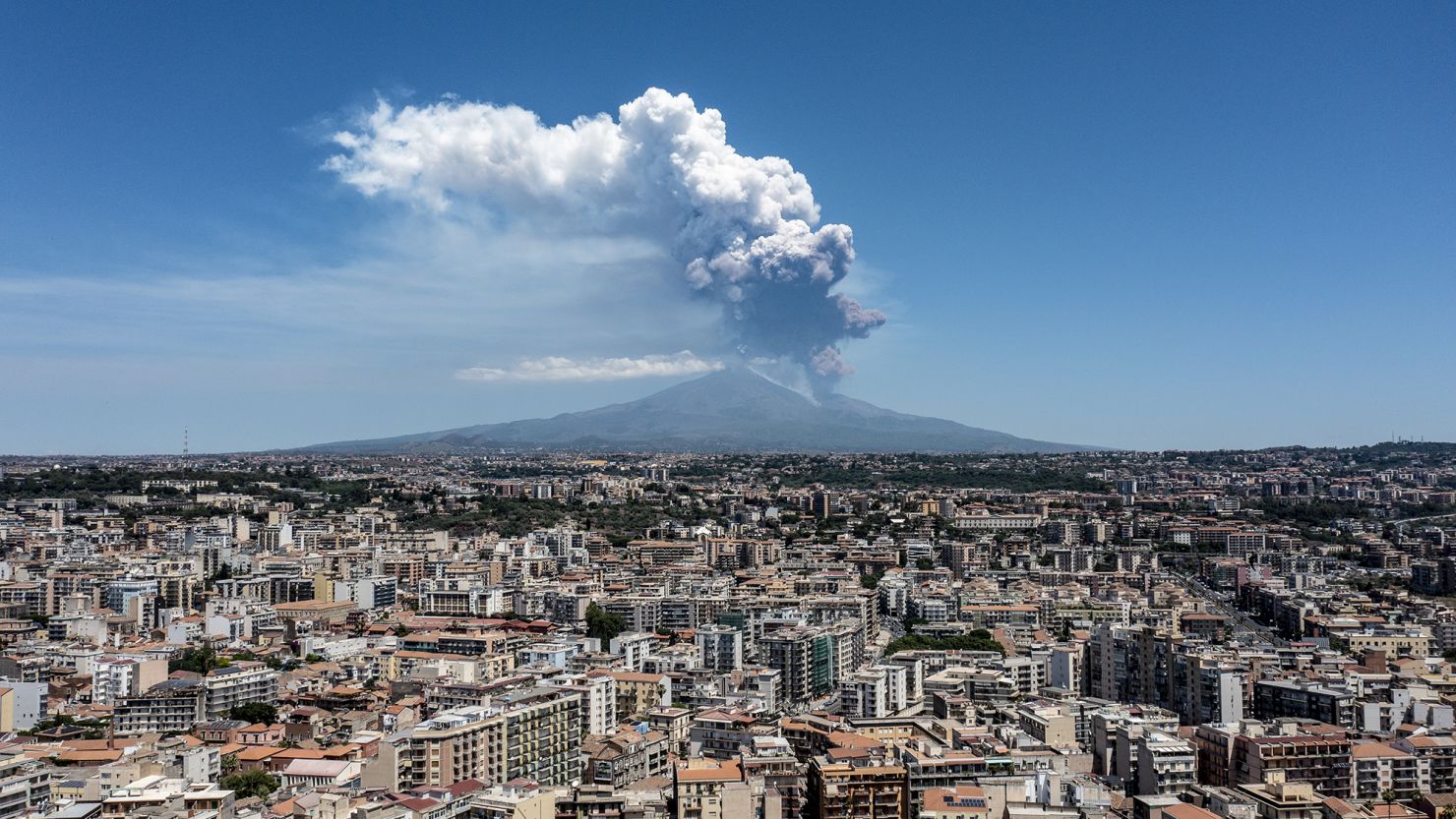
Mount Etna erupted overnight on the Italian island of Sicily, launching a towering column of ash, hot gases, and rock into the sky.
The eruption, one of the most intense in recent months, was powerful enough to shake nearby towns and disrupt air traffic in the region.
The volcanic activity began in the early hours of Monday and quickly gained strength. Explosions were reported by residents in the cities of Taormina and Catania, located up to 50 kilometers from the volcano. Social media was soon flooded with videos showing glowing lava, thick smoke, and the deafening sound of Etna’s fury.
Italy’s National Institute of Geophysics and Volcanology confirmed that the volcano’s southeast crater, a frequent source of eruptions, had partially collapsed. This collapse appears to have triggered the violent outburst, resulting in a fast-moving flow of lava and debris known as a pyroclastic flow. These flows carry high-temperature gases, volcanic ash, and rock fragments and can be extremely dangerous.
By midday local time, Etna began releasing steady streams of lava, echoing similar events from past eruptions. Scientists monitoring the volcano reported a sharp rise in volcanic tremors, indicating ongoing instability beneath the surface.
Authorities have issued a Volcanic Observatory Notice for Aviation, warning aircraft to stay clear of the area. While both Catania and Palermo airports remain operational, some flights have already been rerouted to avoid the ash cloud. The situation is being closely monitored, as changing wind patterns could force further air traffic disruptions.
Despite the scale of the eruption, no injuries have been reported, and the surrounding towns are not currently under evacuation orders. Local emergency services and civil protection agencies are on alert in case the situation escalates.
Mount Etna is Europe’s most active volcano and has erupted frequently in recent years. Its unpredictable behavior continues to pose a challenge for nearby communities, air travel, and scientists working to understand the powerful natural forces at play.
Updates will follow as authorities continue to assess the impact and ongoing risks.