
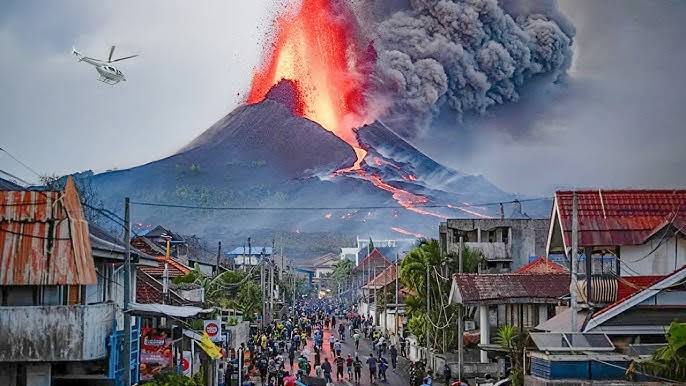
Mount Lewotobi Laki Laki, located on Indonesia’s Flores Island, erupted early Saturday for the second time in less than a day, releasing a massive column of ash and volcanic material that rose as high as 18 kilometers (11 miles) into the sky.
The eruption covered nearby villages in thick volcanic debris, though no injuries or deaths were reported.
The eruption followed an earlier event on Friday evening, when the volcano sent glowing lava and ash clouds up to 10 kilometers (6.2 miles) into the air.
Both eruptions occurred within five hours of each other, raising concerns among local authorities and residents.
Lava bursts and lightning flashes were visible during the Friday night activity.
According to Indonesia’s Geology Agency, a fast-moving flow of hot gas, rocks, and lava traveled up to 5 kilometers (3 miles) down the volcano’s slopes.
Drones captured deep magma movement beneath the mountain, while tremors were recorded by seismic devices placed around the area.
The volcano also ejected thumb-sized gravel and other materials as far as 8 kilometers (5 miles) from the crater.
This has left a thick layer of ash and stone over nearby towns and farmlands.
Authorities have warned locals about possible lava flows if heavy rain mixes with volcanic material along rivers connected to the volcano.
This latest eruption is among the most powerful in Indonesia since Mount Merapi’s deadly event in 2010, which caused more than 350 deaths on Java island.
The current alert level for Mount Lewotobi has remained at its highest since June 18, with the exclusion zone now extended to 7 kilometers (4.3 miles).
Just weeks earlier, a July 7 eruption disrupted air travel across Bali and blanketed roads and rice fields with volcanic mud and rocks.
Previous eruptions in November also led to the deaths of nine people and the destruction of thousands of homes, prompting permanent relocation efforts for residents.
Indonesia, located on the Pacific “Ring of Fire,” experiences frequent volcanic activity and has over 120 active volcanoes.