
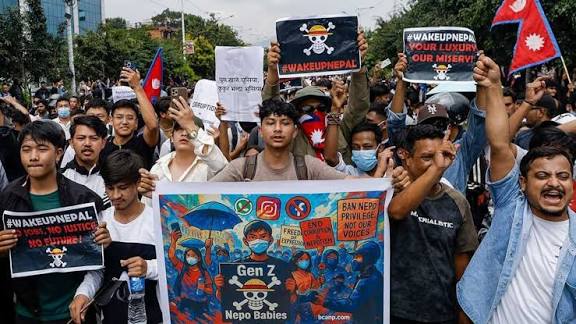
The death toll from Nepal’s youth-led anti-corruption protests has climbed to 51, police confirmed on Friday, as the country struggles to restore order after a week of violent demonstrations that toppled the government.
Police spokesman Binod Ghimire told Agence France-Presse that the casualties include at least 21 protesters, three police officers, and nine prisoners.
The unrest, which swept through Kathmandu and other regions, left government buildings in ruins and forced the resignation of Prime Minister K.P. Sharma Oli.
The protests also triggered one of the largest prison breaks in Nepal’s history. According to Ghimire, around 13,500 inmates escaped during the chaos, with just under 1,000 recaptured so far.
Nearly 12,533 prisoners remain at large, some attempting to cross into India through the porous frontier, where Indian security forces have detained dozens.
Soldiers continue to patrol the capital, enforcing curfews and monitoring checkpoints, while residents slowly return to daily life.
Shattered glass, burned-out government offices, and torched hotels serve as reminders of the upheaval that paralyzed the city.
Amid the turmoil, attention has shifted to the formation of a transitional government. Former Chief Justice Sushila Karki has emerged as the frontrunner to lead an interim administration.
A constitutional expert close to President Ram Chandra Paudel and Army Chief Ashok Raj Sigdel confirmed that Karki is the favored choice of the “Gen Z” movement behind the protests.
“She will be appointed interim prime minister,” the source told Reuters, adding that the announcement was expected after a meeting at the president’s residence on Friday.
Protest leaders say Karki represents integrity and independence, qualities they believe are vital to restoring public trust.
If confirmed, Karki would be the first woman to serve as Nepal’s prime minister, marking a historic shift for the Himalayan nation.
Her potential appointment signals an effort to bridge the demands of the protesters with the need for stability as Nepal navigates its most serious political crisis in years.