
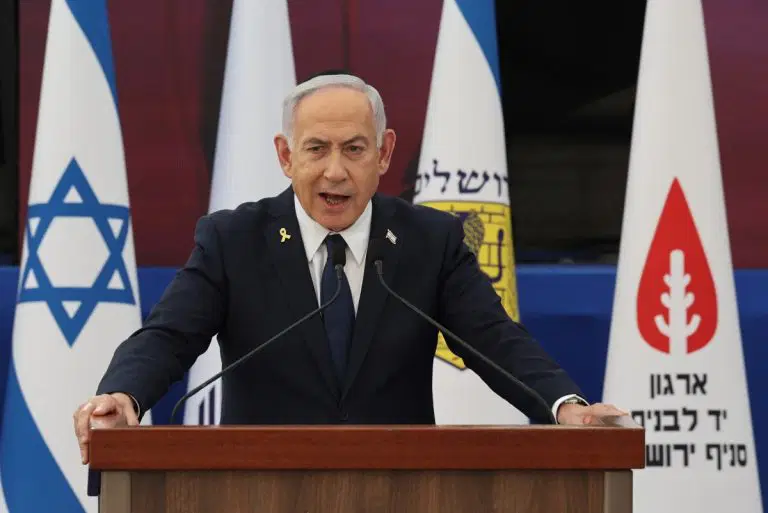
Israeli Prime Minister Benjamin Netanyahu on Friday used his speech at the United Nations to reject the idea of a Palestinian state, describing it as a danger to Israel’s survival.
Speaking in a heated tone, he said recent moves by European countries such as Britain and France to recognize Palestine were rewarding violence and putting Israel at risk.
The address came as fighting continued in Gaza, where Israel has carried out a long and deadly campaign since the October 7, 2023 attack by Hamas. That attack killed more than 1,200 people in Israel, mostly civilians, and led to the ongoing war. According to Gaza’s health ministry, over 65,000 Palestinians, largely civilians, have been killed since the conflict began, while nearly the entire population has been displaced.
Netanyahu declared that Israel would continue its operations against Hamas until its objectives were met. He said his remarks were even broadcast in Gaza on Israeli military loudspeakers, aimed at both Hamas leaders and hostages still being held since the October 7 assault.
In his speech, Netanyahu accused Western powers of supporting what he described as a corrupt Palestinian Authority, while insisting that Israel would not accept a future Palestinian state. He avoided speaking about the possible annexation of the West Bank, an issue that has divided his government, though some ministers have openly pushed for it.
His speech drew sharp criticism. Palestinian officials dismissed his words as the reaction of a leader under pressure. Protests also erupted outside the UN headquarters in New York, with demonstrators demanding his arrest. Many delegates walked out of the assembly hall as he approached the podium, while demonstrators in Times Square accused him of war crimes.
Netanyahu rejected accusations of genocide in Gaza and defended Israel’s actions, saying civilians had been urged to leave targeted areas. However, international law experts argue that forced displacement is itself a crime, and humanitarian groups continue to report massive suffering inside the enclave. Doctors Without Borders announced it had suspended work in Gaza City due to the intensity of the military assault.
The Israeli leader’s UN appearance came after reports that the International Criminal Court is seeking his arrest over allegations of using starvation as a weapon of war. To reach New York, he took an unusual flight path over the Strait of Gibraltar, apparently to avoid possible risks.
The conflict has also drawn responses from other leaders. Palestinian Authority president Mahmud Abbas, speaking virtually a day earlier after being denied a US visa, condemned Hamas’s attack while also rejecting antisemitism. Iranian President Masoud Pezeshkian said his government supported any move that could lead to a ceasefire. Meanwhile, reports suggested former British prime minister Tony Blair might be considered to head a transitional administration in Gaza under a US-backed proposal.
Netanyahu also praised former US President Donald Trump, who earlier said he believed progress had been made toward a deal on Gaza. The two are expected to meet in Washington, with Trump promoting a plan that includes disarming Hamas and avoiding annexation of Palestinian land.
Despite growing international pressure, Netanyahu left no doubt in his UN address that he intends to continue the military campaign and resist any diplomatic efforts to create a Palestinian state.