
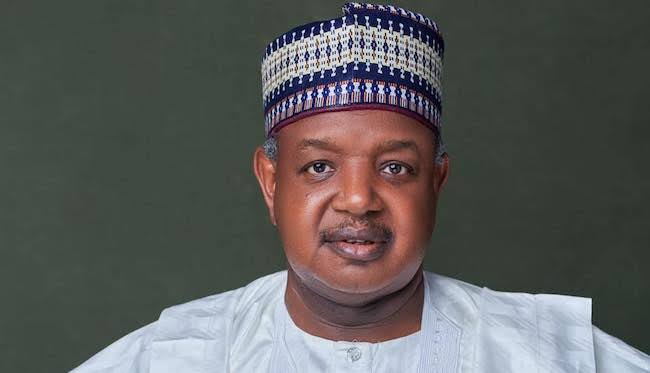
The Minister of Budget and National Planning, Atiku Bagudu, says Nigeria must attract at least $100 billion investments annually to become a middle-income country by 2050.
Mr Bagudu made the statement on Tuesday at a one-day policy dialogue on “Deepening Legislative-Executive Synergy for Effective Economic Governance in Nigeria.”
The event was organised by the National Institute for Legislative and Democratic Studies (NILDS) in Abuja.
The minister explained that Agenda 2050 was not an overly ambitious plan but a realistic pathway to prosperity.
He said President Bola Tinubu had demonstrated that the dream was realisable and had taken risks never attempted in developing countries, adding that the results were beginning to show.
According to him, the renewed hope agenda of Mr Tinubu is a deliberate attempt to reverse years of weak fiscal capacity and systemic distortions.
He said that without bold choices and stronger synergy between the legislature and the executive, Nigeria risked falling further behind its peers in global economic competitiveness.
“We calculated that to achieve this objective, Nigeria requires at least $100 billion investment per annum from both the private and public sectors.
“Agenda 2050 is structured into six medium-term plans, beginning with 2021–2025 and moving in five-year phases until 2050,” Mr Bagudu said.
He stated that the revenue-to-GDP ratio stood at nine per cent in June 2023, “one of the lowest in the world, compared to the EU average of 31 per cent; that has now risen to 16 per cent due to recent reforms, but we are still punching below our weight.
“Brazil, a federation like Nigeria, has a federal budget of about $700 billion, while ours is just $36 billion. Japan, with roughly half of Nigeria’s population, spends more than $20 trillion annually. These disparities explain why outcomes are inevitably different,” he noted.
Rep. Afam Ogene (LP-Anambra) said Nigeria was still grappling with 2024 budget implementation as of September 2025, and local contractors were protesting on the streets, demanding payments for jobs done in 2024.
“A government that is not able to meet its obligation is bankrupt; in simple economics, the budget is the supreme law for the year, made up of revenue and expenditure.
“Engagement must continue because secrecy in government is the incubation of corruption; we need to demand more explanation,” he said.
The director-general of NILDS, Abubakar Sulaiman, said Nigeria’s economic fragility is manifested in high inflation, debt servicing pressures, currency volatility, and weak growth.
Represented by the Director of the Department of Legal Services, Shauibu Danwanka, the NILDS’ boss stated that the country’s economic situation demanded a united front from both arms of government.
(NAN)