
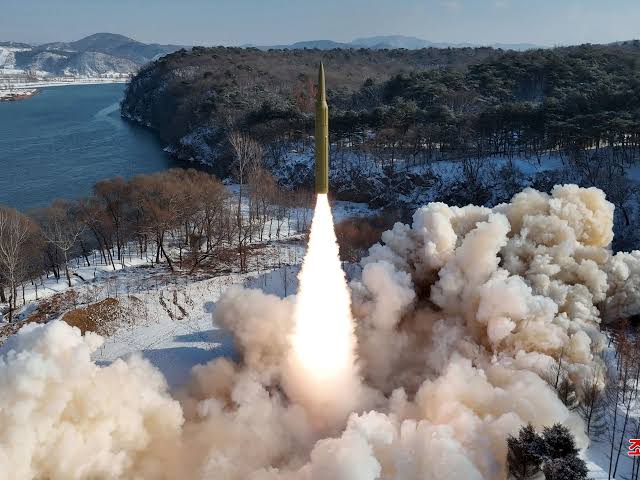
North Korean leader Kim Jong Un has overseen the final ground test of a new solid-fuel engine designed for intercontinental ballistic missiles (ICBMs), according to state media reports on Tuesday.
The move signals Pyongyang’s missile program is nearing readiness for a full-scale launch, possibly before the end of the year.
The Korean Central News Agency (KCNA) described the event as the ninth and final development trial, calling it a ground jet test of a high-thrust engine built with composite carbon fiber material.
Photographs released by state media showed Kim watching through binoculars as the engine fired, producing a long red flame across the test site.
KCNA claimed the engine achieved a thrust of 1,971 kilonewtons, a figure that far exceeds international benchmarks but remains unverified.
Kim reportedly declared the system a milestone in strengthening North Korea’s nuclear strategic forces.
Analysts say the adoption of solid-fuel technology represents a new phase of threat because such missiles can be pre-fueled, making them faster to launch and more difficult to track compared to liquid-fuel versions.
Yang Moo-jin, former head of the University of North Korean Studies, told AFP the test suggests North Korea is now capable of producing solid-fuel engines for its newest generation of ICBMs, making a launch in the coming months highly likely.
The announcement comes only a week after Pyongyang revealed the Hwasong-20 missile, touted as a next-generation ICBM.
It also follows Kim’s high-profile visit to Beijing for a World War II commemoration alongside Chinese President Xi Jinping and Russian President Vladimir Putin.
North Korea has increasingly leaned on its partnership with Moscow since Russia’s invasion of Ukraine, providing troops and weapons while, in return, reportedly receiving technical support and financial assistance that could be accelerating its missile advancements.
If Pyongyang proceeds with a launch, it would mark one of the most serious escalations in recent years, placing further pressure on U.S. and allied security strategies in the Asia-Pacific region.