
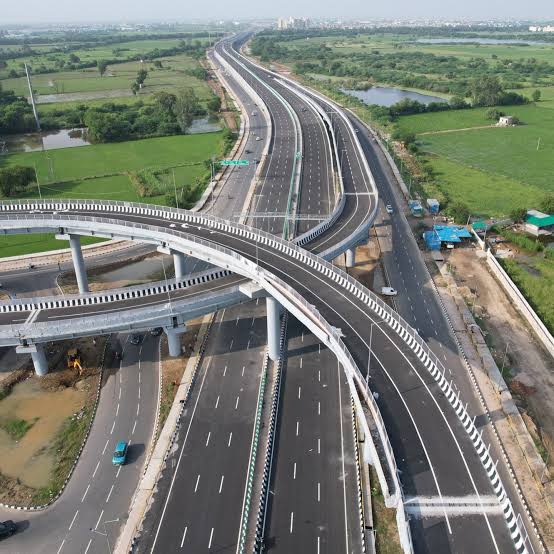
Prime Minister Narendra Modi on August 17, 2025, officially inaugurated two flagship road projects in Rohini—the Delhi section of the Dwarka Expressway and the Urban Extension Road-II (UER-II)—together worth nearly $1.3 billion.
The 10.1 km Delhi segment of the Dwarka Expressway, built at approximately $642 million, connects the Shiv Murti intersection to the Delhi–Haryana border via the Dwarka Sector-21 Road Under Bridge.
It enhances multimodal integration by linking with the Yashobhoomi convention centre, Delhi Metro’s Blue and Orange lines, the upcoming Bijwasan railway station, and the Dwarka bus depot.
The UER-II stretch, including the Alipur to Dichaon Kalan section with new links to Bahadurgarh and Sonipat, cost around $670 million.
Extending about 75.7 km, this six-lane expressway forms a semicircle across west Delhi, enhancing access to NH-44, Rohini, Mundka, Najafgarh, Dwarka, and the Delhi–Gurugram Expressway (NH-48).
These corridors are designed to relieve heavy traffic on Delhi’s Inner and Outer Ring Roads and ease congestion at major junctions like Mukarba Chowk, Dhaula Kuan, and NH-9.
Commuters can now travel from the Singhu border to IGI Airport in about 40 minutes, and journeys between Delhi and Gurugram may drop to 30 minutes.
The enhanced connectivity has already sparked a sharp rise in property values. Along the Dwarka Expressway corridor, real estate prices nearly doubled from about $113 per sqft in 2020 to $224 per sqft in 2024.
A typical 3BHK apartment has increased in value from around $216,000 in 2022 to $312,000–$480,000 today.
This inauguration is a key part of a broader $6 billion infrastructure roadmap aimed at transforming Delhi into a “world-class city” by enhancing travel efficiency and urban development.
Union Minister Nitin Gadkari noted the potential to halve traffic congestion and reduce logistics costs from 14–16% to single-digit figures by 2026.