
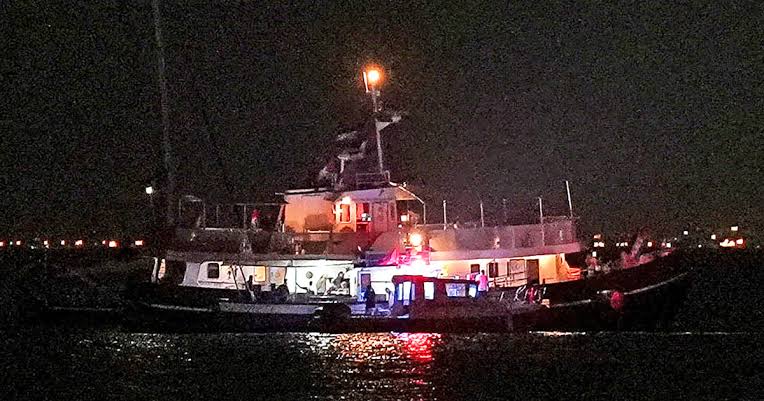
Conflicting accounts emerged Tuesday after an explosion struck a Portuguese-flagged vessel linked to the Global Sumud Flotilla (GSF) as it sailed in the Mediterranean.
The GSF, an activist group that organizes voyages challenging Israel’s blockade of Gaza, claimed the vessel was hit by a drone.
According to its statement, no passengers or crew were injured. Tunisian authorities quickly rejected that version.
A spokesperson for the National Guard told local broadcaster Mosaique FM that a preliminary inspection suggested the blast originated inside the ship rather than from an external strike. Further investigations are underway.
The incident comes against the backdrop of Israel’s long-standing naval blockade on Gaza, first imposed in 2007 after Hamas seized control of the enclave.
Israeli officials have long argued the blockade is necessary to prevent weapons shipments to armed groups, while rights organizations and activists accuse it of collectively punishing civilians.
Meanwhile, diplomatic tensions in Europe deepened. Spain’s government announced it would bar any ship or aircraft transporting weapons to Israel from passing through Spanish ports or airspace.
The decision is part of nine measures Madrid recently unveiled to protest what it describes as Israel’s “genocide” in Gaza.
Israeli foreign minister Gideon Saar condemned Spain’s move, labeling it antisemitic and politically motivated.
In a parallel decision, Spanish authorities also declared that individuals directly involved in alleged war crimes in Gaza would be denied entry into Spain.
Prime Minister Pedro Sanchez has been among Europe’s most outspoken leaders on Gaza, intensifying criticism of Israel’s military actions while pushing for stronger international accountability.
The dual developments—a disputed explosion at sea and Spain’s arms embargo—add new layers of friction to an already volatile regional crisis, where naval activity, airspace restrictions, and diplomatic clashes intersect.