
The death of delivery rider Affan Kurniawan has sparked widespread protests in Jakarta and several other Indonesian cities, bringing attention to workers’ rights, police conduct, and economic grievances.
Kurniawan’s funeral on Friday drew thousands of mourners, including family, colleagues, and prominent public figures such as Jakarta police chief Asep Edi Suheri, politician Rieke Dyah Pitaloka, and former Jakarta governor Anies Baswedan.
While officials expressed condolences and promised a thorough investigation, they also urged protesters to avoid actions that could escalate tensions.
President Prabowo Subianto issued a personal apology to Kurniawan’s family, describing the incident as shocking and expressing disappointment over the excessive behavior of the officers involved.
Jakarta governor Pramono Anung also visited the family, offering condolences and financial assistance for funeral arrangements.
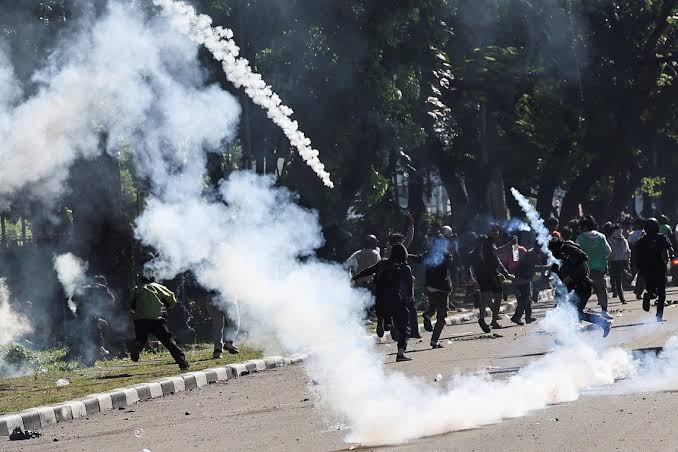
Despite these gestures, protests intensified throughout the day. Demonstrators gathered outside the Indonesian National Police headquarters in Kwitang, blocking roads and throwing rocks, firecrackers, and Molotov cocktails at police vehicles.
Officers responded with tear gas, and marine and army units were deployed to prevent further escalation. Students from Pertamina University and riders from Gojek joined the demonstrations, adding numbers and energy to the protests.
Drone footage of Kurniawan’s funeral showed thousands of Gojek riders turning out in solidarity, many on motorcycles wearing the company’s signature green jackets.
Similar protests were reported in cities including Jawa Barat, Surakarta, Bandung, and Medan.
Seven members of the Mobile Brigade Corps (Satbrimob) were found to have violated police professional ethics in connection with Kurniawan’s death.
While this announcement addressed part of the public’s concern, it did little to reduce anger.
Protesters displayed banners demanding arrests and accountability, reflecting widespread frustration with law enforcement and the perception of impunity among officers.
Gojek, Kurniawan’s employer, released a statement mourning his death and pledging support to his family.
The company described him as a valued member of its community and highlighted the challenges faced daily by delivery riders, many of whom risk their safety to earn a living.
The protests also drew attention to broader social and economic issues. Demonstrators criticized a new monthly allowance for lawmakers that is nearly ten times the minimum wage in Jakarta.
Other demands include higher wages for workers, lower taxes, and stronger anti-corruption measures.
Kurniawan’s death has become a symbol for larger calls for justice, fair treatment, and accountability across Indonesia.
As tensions continue to rise, authorities face the challenge of addressing both immediate demands for justice and the underlying social and economic grievances that have fueled nationwide demonstrations.
Kurniawan’s passing has not only sparked mourning but also ignited a nationwide conversation about the treatment of delivery riders, law enforcement accountability, and economic inequality in Indonesia.