
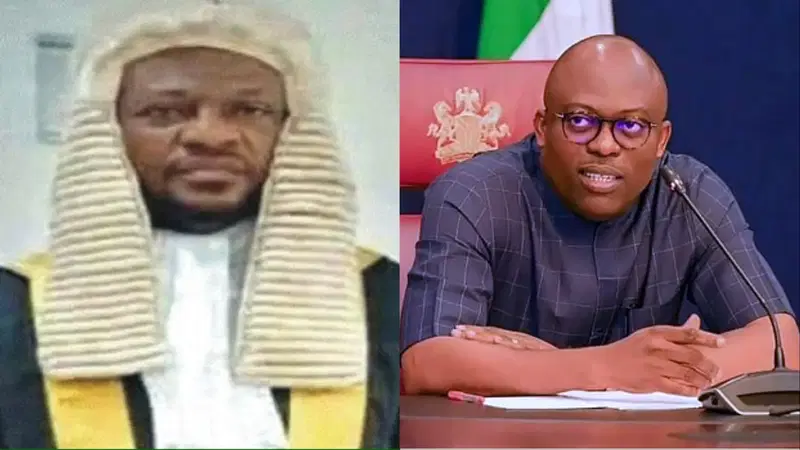
The return of democratic rule in Rivers State after six months of emergency control began with tension and mixed feelings as Governor Siminalayi Fubara and his deputy, Prof. Ngozi Odu, were absent when the State House of Assembly reconvened in Port Harcourt.
Supporters who had gathered at the Government House as early as 7 a.m. from across the 23 local government areas waited in expectation of the governor’s arrival but left in disappointment around 7 p.m. when it became clear he would not appear. The governor, who left the country shortly after his suspension on March 18, was expected to return following President Bola Tinubu’s announcement lifting emergency rule on September 17.
Speculation spread over why Fubara did not return as planned. While some residents feared he might have lost political ground, sources revealed that he was still in Abuja meeting with political stakeholders on the next steps before resuming in Rivers. Former governor and now Minister of the Federal Capital Territory, Nyesom Wike, stated in a television interview that he had spoken with Fubara, who assured him of readiness to come back and resume his duties.
Earlier in the day, Vice Admiral Ibok-Ete Ibas (retd), who had served as sole administrator of the state during the emergency period, officially handed over to elected officials, ending his six-month tenure. Ibas said his task of restoring order had been achieved, pointing to the conduct of local government elections, the passage of a state budget through the National Assembly, and the reconstitution of state boards and commissions. He called on residents to support Fubara and cautioned political actors against returning the state to chaos.
Meanwhile, the Rivers State House of Assembly held its first sitting after suspension. Lawmakers asked Governor Fubara to submit a list of commissioner-nominees for screening and also present an appropriation bill that would address the realities of the state. The motion, moved by the House leader and supported by members, set a legislative agenda for the 10th Assembly, including a review of events during the emergency rule. Speaker Martin Amaewhule praised the president for restoring democratic institutions and pledged that the House would work with the governor in line with constitutional provisions and the peace terms earlier agreed upon.
Outside the Government House, thousands of supporters waited for hours, some wearing uniforms of various groups linked to the Simplified Movement, Fubara’s political structure. Banners with photographs of his allies were displayed, and several former local government chairmen loyal to him were in attendance. However, those associated with Wike were notably absent. By evening, many supporters left frustrated, saying they had waited in vain.
In the wider political space, reactions poured in. Former Vice President Atiku Abubakar described the suspension and later reinstatement of Fubara as unconstitutional, insisting that Tinubu lacked the power to remove elected officials. Labour Party’s Peter Obi called the episode a misstep that hurt democracy, warning that lessons must be learned. The African Democratic Congress (ADC) also condemned the president’s role, accusing him of setting a dangerous precedent that undermines state autonomy.
Despite these criticisms, Wike insisted reconciliation had taken place between him and Fubara, adding that peace had returned to the state. He also accused some individuals of trying to prolong the crisis by twisting legal interpretations surrounding local government elections.
For now, Rivers residents remain caught between relief at the restoration of democratic governance and uncertainty over the governor’s continued absence, as the state awaits his return to assume full control of government activities.