
By SUNDAY ABBA, Abuja
Federal Government of Nigeria (FGN) has reaffirmed its commitment to safeguarding Nigeria’s critical road infrastructure across the country.
Minister of Works, Engr David Umahi stated this Thursday at the ministry’s headquarters in Abuja in response to recent damages to the structural integrity of key bridges and flyovers, nationwide, according to a statement signed by Mohammed Ahmed, director, Public Relations in the ministry.
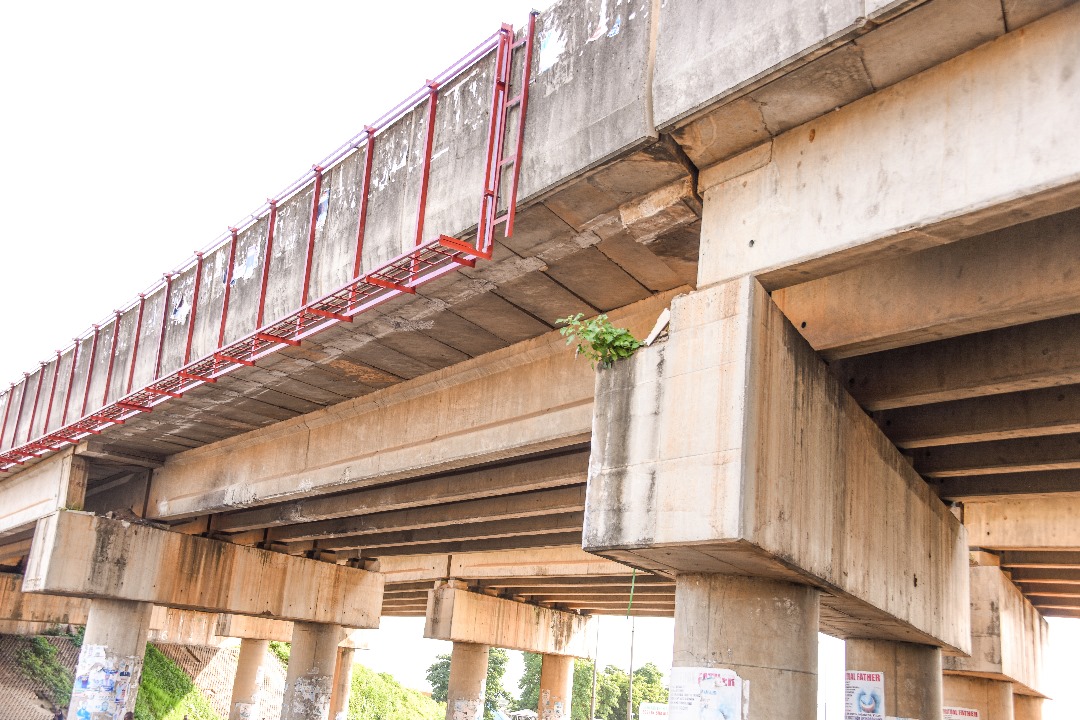
Engr Umahi cited a recent structural incident at the Keffi Flyover, which prompted an immediate technical evaluation. The investigation revealed that the damage was caused by a container-laden trailer exceeding the permitted clearance height, highlighting a national disregard for vehicle height and load regulations.
“When the height or weight of what you’re transporting exceeds the permitted clearance, it directly compromises the structural integrity of bridges and flyovers,” the minister stated.
Continuing, he said, “These infrastructures were never designed to accommodate such abuse. A single impact from an overloaded or improperly configured vehicle can lead to multi-billion-naira damage and threaten lives, as well as properties.”
The minister also noted that the minimum standard headroom for flyovers and interchanges ranges between 5.5 and 6.5 metres, and that violating this engineering requirement not only breaches federal regulations but also significantly shortens the lifespan of essential transport infrastructure.
Engr Umahi reported that no fewer than seven bridges along the Lagos–Ibadan Expressway have suffered structural compromises due to similar violations. He referenced the Eko Bridge, which was damaged by fire under the previous administration and currently undergoing rehabilitation; it is now 80% complete, thanks to expedited funding approval by President Bola Ahmed Tinubu.
Addressing the state of the 3rd Mainland and Carter Bridges in Lagos, Umahi acknowledged the discomfort faced by commuters due to ongoing maintenance exercises as witnessed during a recent inspection and urged them to be patient.
He reaffirmed that integrity tests were essential to ensure the long-term safety of the structures and the millions of Nigerians who use them daily. “We appreciate the patience of Nigerians during this time. All findings from our assessments are being addressed with precision, and every repair and reinforcement is being executed according to international engineering standards. No shortcuts will be taken,” he assured.
The minister also announced that the ministry, in collaboration with enforcement agencies, would launch a nationwide crackdown on non-compliant vehicles. This initiative includes strict enforcement of weight load regulations, clearance heights, and transport configurations across federal roads and bridges.
The Permanent Secretary, Engr Olufunsho O. Adebiyi, echoed the minister’s sentiments, emphasising that bridge protection is a shared responsibility, not solely the government’s.
“The bridges across Nigeria are a critical component of the nation’s economic and transport network. These structures are designed and constructed with load and height specifications. When motorists, especially operators of heavy-duty vehicles, ignore these, they place undue stress on our infrastructure, leading to premature and costly damage,” he stated.
Engr Adebiyi urged transport unions, construction firms, logistics companies, and motorists to comply with the federal regulations to preserve public assets and ensure road safety.
“The government alone cannot monitor every kilometre of road or every single bridge. This must be a collective effort. We are open to collaboration, sensitisation, and enforcement because Nigerians must understand that protecting our roads is in our shared interest,” he affirmed.
In conclusion, the ministry also called on all stakeholders—transport unions, construction companies, logistics operators, and road users—to join hands with the government in ensuring that the nation’s infrastructure investments are not rendered futile by negligence and lawlessness.