
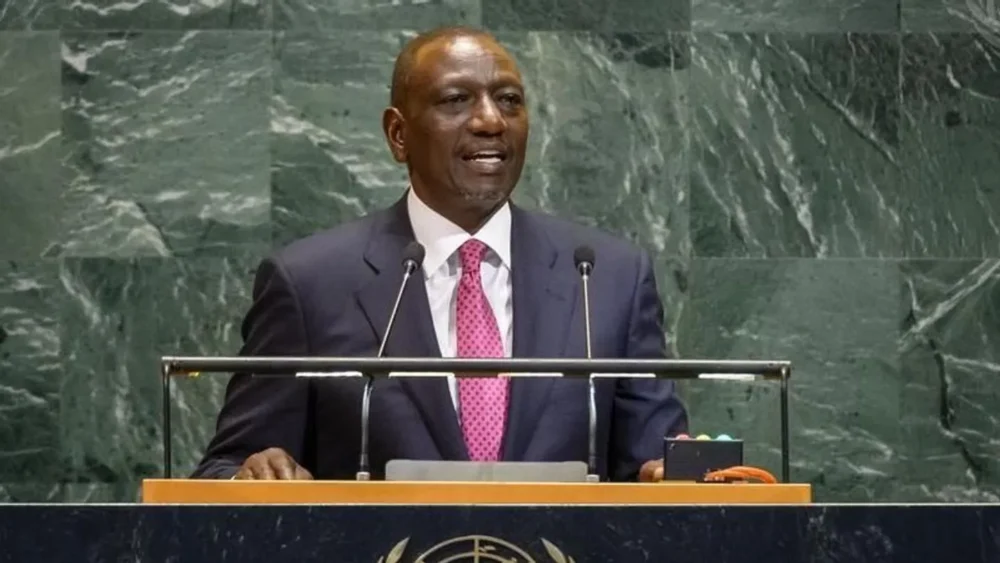
Kenya’s President William Ruto on Wednesday delivered a sharp address at the 80th United Nations General Assembly (UNGA) in New York, where he raised concerns over global conflicts, financial inequality, and the need for reforms within the UN and international lending institutions.
In his speech, Ruto criticised international financial bodies such as the International Monetary Fund (IMF) and the World Bank for the way they treat African nations. He argued that wealthier countries receive more money and better terms, while African states are left with smaller loans tied to heavy conditions and high interest rates. He described the trend as unfair, pointing out that during a recent IMF allocation of Special Drawing Rights, the poorest countries received only a tiny fraction compared to wealthy nations that had little need for financial aid.
On UN reforms, the Kenyan leader said Africa must be given two permanent seats with veto power and two additional non-permanent seats on the Security Council. He maintained that this demand is not a request for favour but a necessity for the survival and fairness of the UN, given that Africa dominates most of the Council’s agenda but lacks permanent representation where major decisions are made.
Ruto also drew attention to the credibility crisis facing the UN, saying that the organisation has often been overshadowed by the power struggles of global rivals. He noted that its peacekeeping missions no longer carry the same weight, citing ongoing crises in Gaza, Ukraine, Sudan, Somalia, and the Sahel as evidence that warring parties continue to act without regard to UN appeals.
On Sudan, Ruto said the civil war between the Sudanese Armed Forces and the Rapid Support Forces can only be solved through political dialogue, not military action. He called on all sides and external players to respect Sudan’s sovereignty and unity, stressing that attempts to break up the country must be rejected.
Ruto also spoke about Kenya’s leadership of the UN-backed security mission in Haiti, explaining that despite severe funding shortages, lack of equipment, and fewer than half of the authorised personnel in place, Kenyan officers remain committed to the mission.
Touching on global divisions, he said mistrust, fragmentation, and fear are replacing unity and solidarity. He urged the international community to rethink peace efforts, noting that the UN is struggling with reduced funding, slow bureaucracy, and outdated Security Council structures that no longer reflect present realities.