
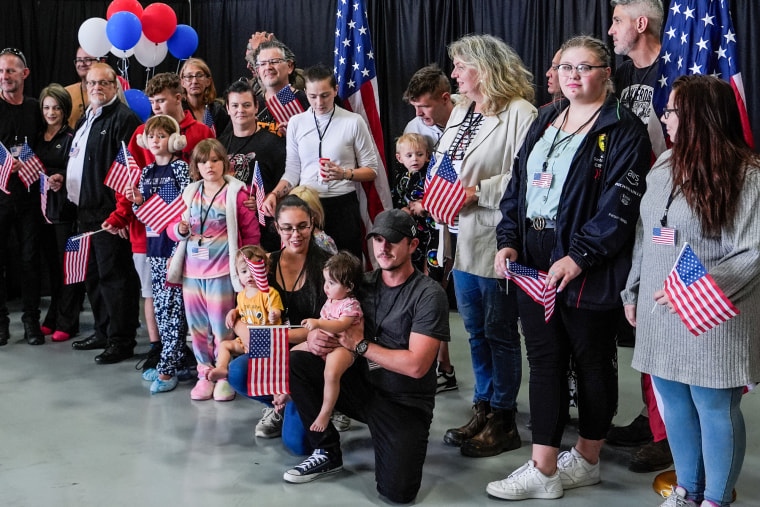
A second group of white Afrikaners has arrived in the United States under President Donald Trump’s resettlement program, amid disputed claims of white genocide and persecution in South Africa. The group, which includes children, landed in Atlanta, Georgia, on a commercial flight and will join others in southern states such as Texas, North and South Carolina, Kansas, Oklahoma, and Nebraska.
According to Jaco Kleynhans, head of Public Relations for trade union Solidarity, “It is a smaller group, including children. Several more groups will fly to the USA over the next few weeks.” The US Embassy in Pretoria, in collaboration with the State Department in Washington DC, is currently processing 8,000 applications, with many more Afrikaner refugees expected to travel to the USA in the coming months ¹.
The resettlement program has sparked controversy, with South African President Cyril Ramaphosa dismissing claims of Afrikaner persecution. “A refugee is someone who has to leave their country out of fear of political persecution, religious persecution, or economic persecution. And they don’t fit that bill,” Ramaphosa said. Kleynhans, however, maintains that their primary focus is not refugee status but ensuring a free, safe, and prosperous future for Afrikaners in South Africa ².
Kallie Kriel, AfriForum’s CEO, emphasized that Afrikaners feel threatened by open calls for violence, such as the “Kill the Boer” chant. “No community should be targeted through calls for violence… We want to address that, and that is why we are vocal, because we want to make sure that South Africa truly belongs to all who live in it,” Kriel said ¹.
The US government’s decision to resettle Afrikaners has been met with skepticism by some experts. Dr. Noluthando Phungula, an international relations expert, believes it’s unlikely there will be a large exodus, as the privileged white Afrikaner population won’t want to leave their life of privilege and comfort in South Africa. Professor Siphamandla Zondi, a political analyst, suggests that poor Afrikaners may take advantage of the program to get a “free pass” to the US in search of basic jobs.