
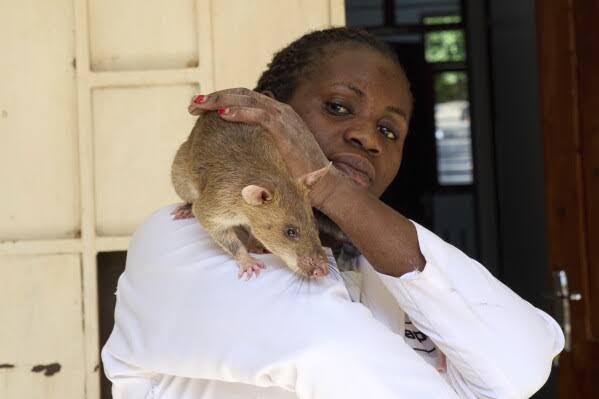
In Tanzania, African giant pouched rats are being trained for missions that save lives—from detecting hidden landmines to diagnosing tuberculosis and even locating survivors trapped under rubble.
For over 20 years, the Belgian non-profit APOPO has operated in Morogoro, using classical conditioning and positive reinforcement to train the rodents.
Rat trainer Sophia Madinda explained that the animals first learn to distinguish between positive and negative samples before advancing to real-world work.
She said her initial fear of rodents gave way to respect once she saw their ability to adapt and cooperate.
The rats’ sharp sense of smell has proven especially valuable in tuberculosis detection.
Since 2007, APOPO has expanded the program to hospitals in Tanzania, Ethiopia, and Mozambique, where the animals help uncover cases missed by standard tests.
While not officially recognized as diagnostic tools, the rats have helped identify more than 30,000 TB cases—preventing hundreds of thousands of potential secondary infections, according to APOPO’s CEO Christophe Cox.
Researchers believe the rodents detect unique volatile organic compounds in TB-positive samples.
Beyond disease and mine detection, the organization is pioneering a new use: training the so-called “hero rats” for search and rescue.
With their small size, they can crawl into spaces inaccessible to dogs and carry tiny backpacks equipped with microphones to help rescuers communicate with trapped victims.
A first group of these specially trained rats has already been deployed in Turkey with a partner rescue organization. Each rat begins training soon after birth, costs about $7,000 to prepare, and can work for nearly a decade due to their relatively long lifespan.
Despite skepticism from regulators and the medical community, APOPO continues to expand the program, seeing the animals as a low-cost, effective tool in humanitarian work.
From minefields to hospitals to disaster zones, Tanzania’s hero rats are proving that even the smallest creatures can play an outsized role in saving lives.