
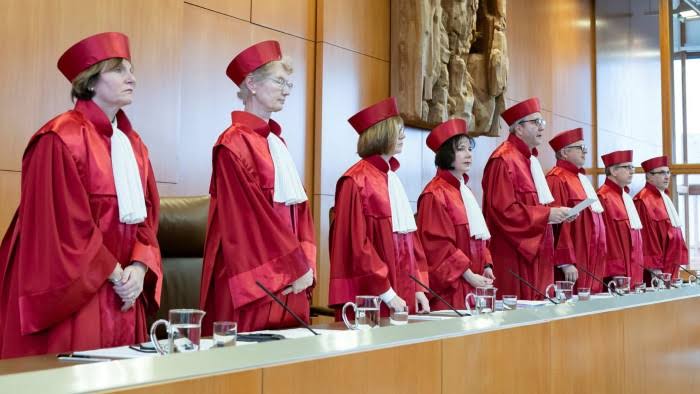
Germany’s political scene is facing growing tension following the delay in electing three new judges to the Federal Constitutional Court.
The election, which requires a two-thirds majority in both the Bundestag and Bundesrat, has been put on hold with no new date set.
The delay comes just days before the summer recess, which will pause parliamentary activity until September.
The federal president formally appoints the selected judges, but only after the required majorities are secured in both legislative chambers.
This process relies heavily on cross-party coordination, since parties in parliament are responsible for nominating the candidates.
The current delay reflects deeper coordination problems within the governing coalition, made up of the SPD, Greens, and FDP.
The Greens have openly voiced their frustration, warning that the government cannot afford to stall such important decisions.
They are now pushing for a special Bundestag session next week to complete the vote, arguing that the credibility of the court and the candidates must be respected.
Green parliamentary leaders say the blocked vote has created a serious political strain and is fueling uncertainty about the government’s stability.
Vice Chancellor Lars Klingbeil, representing the SPD, echoed the need for stronger leadership during disagreements.
Speaking in the Bundestag, he called for accountability but avoided directly criticizing the CDU, whose cooperation is also necessary to reach the required majority.
The CDU, meanwhile, has remained cautious in its public remarks, but internal talks point to disagreements over the candidates’ political alignment.
The lack of consensus appears to be rooted in ongoing mistrust between coalition and opposition parties, especially on judicial matters.
The Federal Constitutional Court plays a crucial role in shaping German law and democracy. Any delay in its appointments sends signals beyond Berlin.
Observers warn that this deadlock may undermine public confidence in both the court’s independence and the coalition’s ability to govern.