
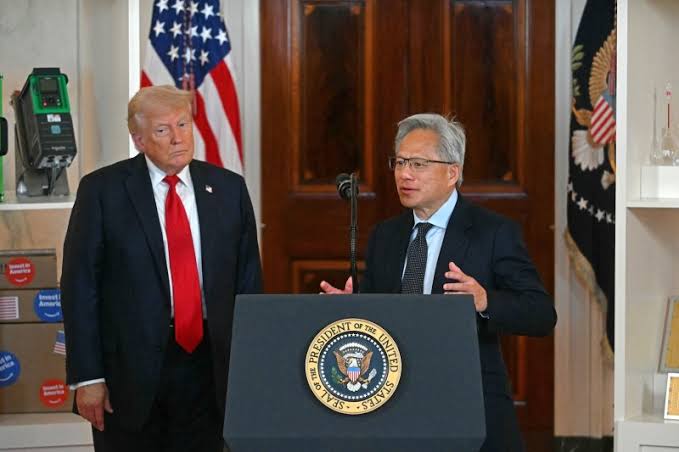
President Donald Trump’s decision to ease restrictions on Nvidia’s H20 chip has created unexpected friction with Beijing.
Instead of welcoming the move, China has reacted cautiously, citing security risks and urging its companies to avoid large-scale use of the chip.
The muted response underscores China’s focus on building a self-sufficient semiconductor ecosystem, even as it continues to rely heavily on American technology.
The H20, a chip derived from Nvidia’s advanced processors but tailored to meet U.S. export rules, was initially banned in April.
Trump reversed course last month, calling it “obsolete” compared with the company’s cutting-edge models such as Blackwell and H100.
His administration argued that keeping Nvidia’s ecosystem dominant would reinforce U.S. leadership in AI. Nvidia has defended the chip, denying claims it contains backdoors or remote access features.
China’s skepticism reflects both political signaling and practical concerns.
Authorities have summoned Nvidia for explanations, while some domestic firms have been told not to rely on H20 units.
Yet, demand remains strong. Research firm Bernstein estimates that sales to China could have reached 1.5 million units in 2025, valued at about $23 billion, had restrictions not been imposed.
Buyers include ByteDance, Alibaba, and Tencent, which continue to value Nvidia’s mature ecosystem despite concerns.
Meanwhile, China’s top semiconductor firms, including Huawei, have rolled out AI chips with computing power comparable to H20.
But these chips still lag behind in memory bandwidth, a crucial factor for AI training, due to China’s dependence on High Bandwidth Memory (HBM) technologies dominated by SK Hynix, Samsung, and Micron.
Domestic producer ChangXin Memory Technologies is several years behind.
The limited production capacity of Huawei and other local firms also creates supply bottlenecks.
Analysts note that Nvidia retains a “moat” because its chips are integrated with a powerful software platform that Chinese alternatives have yet to match.
This makes switching costly for developers already locked into the Nvidia ecosystem.
Even so, China is accelerating its domestic chip drive. Years of U.S. export restrictions have fueled both urgency and state support, helping domestic firms gain ground in manufacturing equipment and advanced packaging.
Bernstein projects that Chinese-made AI chips could rise from 17% of the market in 2023 to 55% by 2027, while U.S. suppliers’ share could shrink to under half.
The issue highlights the delicate balance between Washington’s efforts to safeguard national security and Beijing’s determination to reduce foreign dependence.
While Trump’s move offers Nvidia a reprieve in its most important overseas market, Beijing’s muted reaction signals that China’s long-term bet is on self-reliance.