
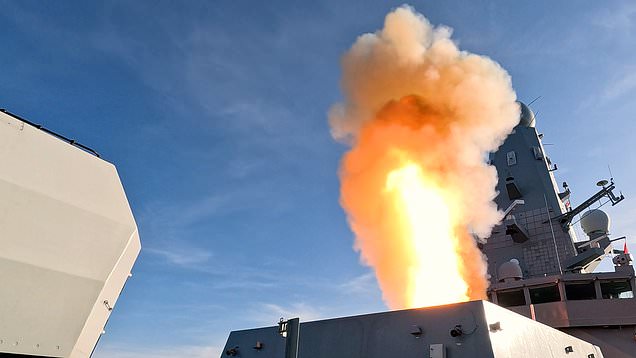
In a landmark moment for British naval defense, HMS Dragon, a Type 45 destroyer, has successfully intercepted and destroyed a supersonic missile during a live-fire test — a first in Royal Navy history.
The breakthrough came during Exercise Formidable Shield 2025, a large-scale NATO air and missile defense exercise involving over 7,000 personnel from 11 allied nations. Conducted off the coast of Scotland at the Ministry of Defence’s Hebrides firing range, the test demonstrated the Royal Navy’s growing ability to counter high-speed missile threats.
The missile intercepted by Dragon was a “supersonic sea-skimming” target designed to mimic the flight characteristics of real-world anti-ship missiles. Flying at Mach 4 (four times the speed of sound), it performed complex evasive maneuvers — including corkscrew dives — to fool detection and interception systems.
Dragon’s Sea Viper missile system, guided by the ship’s Sampson radar, engaged and destroyed the target in a matter of seconds. According to the Royal Navy, the interceptor missile itself reached Mach 4 in just 2.5 seconds, achieving a direct hit high above the water.
“This is a huge moment for HMS Dragon,” said Commander Iain Giffin, the ship’s commanding officer. “It proves our world-leading air defense capability and confirms our readiness to operate jointly with NATO allies.”
Lieutenant Commander Sarah Kaese, on exchange from the Royal Australian Navy, called the experience “a significant challenge and opportunity for Dragon to come together as a warfighting unit and integrate into a task group developing air defense capability.”
Formidable Shield 25 is a biannual NATO drill focusing on integrated air and missile defense (IAMD), with contributions from land, sea, and air forces. It began in Norway and now continues off Scotland’s coast. The success of HMS Dragon highlights the UK’s role in strengthening collective NATO defense against evolving missile threats, from both high-tech hypersonics to lower-tier drones.
This test sets a new benchmark for naval missile defense, underscoring the Royal Navy’s commitment to cutting-edge capability in an increasingly contested global environment.