
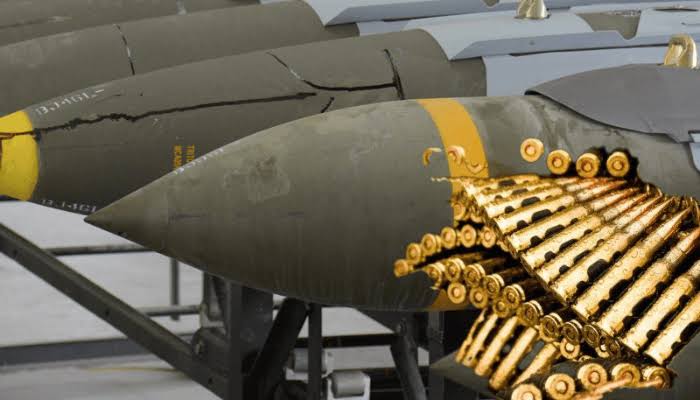
The United States has authorized a proposed $346 million foreign military sale to Nigeria, aimed at strengthening the country’s ability to respond to terrorist threats and maritime security challenges.
The State Department confirmed the deal after notifying Congress through the Defense Security Cooperation Agency.
The request from Abuja includes an extensive range of munitions and equipment.
Among the items are 1,002 MK-82 general-purpose 500-pound bombs, components for Paveway II laser-guided munitions, and programmable bomb fuzes.
Nigeria has also requested 5,000 Advanced Precision Kill Weapon System II (APKWS II) rounds, high-explosive rockets, and training ordnance.
The package covers bomb kits, impulse cartridges, and other essential parts needed for deployment.
Support services will be part of the deal, including technical assistance, engineering support, and logistics provided by U.S. government and contractor personnel.
The main contractors identified are RTX Missiles & Defense, Lockheed Martin, and BAE Systems.
The State Department stated that no additional U.S. defense personnel will be stationed in Nigeria for the implementation of this agreement.
Washington views Nigeria as a key partner in Sub-Saharan Africa and says the sale will not upset the military balance in the region.
The weapons are intended to enhance Nigeria’s capabilities in counter-terrorism operations, particularly against Boko Haram and the Islamic State West Africa Province (ISWAP), as well as to counter illicit trafficking in the Gulf of Guinea.
Nigeria continues to face a persistent insurgency in the northeast, where militant attacks have displaced large populations and caused heavy casualties.
Over the past eight months, the Nigerian military has reported killing hundreds of insurgents in Borno State as part of intensified operations.
Officials say recent air campaigns have been more targeted, focusing on disrupting supply chains and neutralizing high-value militant figures.
The arrival of advanced precision-guided weapons from the United States could further strengthen Nigeria’s offensive operations and help sustain pressure on armed groups threatening national stability.
The deal is still subject to congressional review before it can be finalized.