
By Omonu YG Nelson
The Cultural Counselor of the Chinese Embassy and Director of the China Cultural Centre in Nigeria, Mr. Li Xuda, has stated that for Nigeria and China to fully realise the potential of tourism, we must harness the power of tourism volunteers.
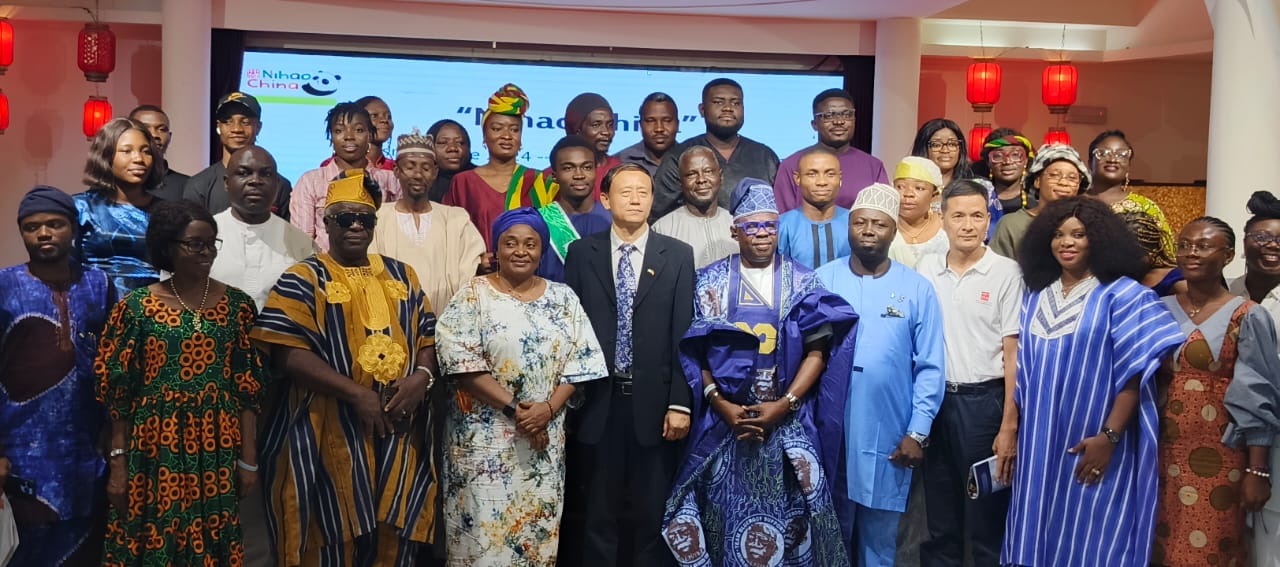
Speaking at the “Nihao China” Tourism Course 2024 in Abuja, Thursday, August8t, 2024, Mr. Li said we were there to overcome challenges and foster partnerships. To fully realize the potential of tourism, we must harness the power of the private sector.
He said, “Today, we are gathered to promote cultural and tourism exchange between our two countries through co-hosting the ‘Nihao China’ Tourism Course 2024!”
Li commended the Nigerian Tourism Volunteers Network for its valuable contribution to the development of the Nigerian tourism industry and the improvement of Nigeria’s image in the world.
Speaking as a cultural counselor, I have always regarded promoting people-to-people ties between China and Nigeria as the focus of my work.
The Director explained that, in his eyes, cultural and tourism exchange plays a special and important role in our social progress and national development.
” People-to-people bonds, one of the five cooperation priorities of the BRI, go beyond culture and tourism exchange and seek to build common understanding out of respect for countries and regions in its big family.
“Both China and Nigeria are cultural giants with fabulous ancient civilizations and rich tourism resources. The tourism sector has been described by the UNWTO as one of the world’s largest and fastest-growing industries.
“Six years ago, China and Nigeria became close partners in jointly building the BRI, which made our bilateral exchange even more in-depth and practical.”
In her welcome remarks, Acting Director of the Tourism Department, Social Development Secretariat, FCTA, Nenadi Dogo, explained that Nigeria has much to offer the world, from its rich cultural heritage to its vibrant tourism industry.
According to her, “We firmly believe that enhancing the skills and knowledge of both our tourism staff and volunteers is crucial for realizing the full potential of our cultural exchanges.”
She explained that this investment in capacity building would not only elevate the quality of our tourism services but also ensure that our efforts in fostering mutual understanding are successful and sustainable.
However, to fully unlock the benefits of this exchange, we must address the language barriers that currently exist between us. We must pave the way for a sustained relationship that honors the wisdom of our nations’ founders who saw the value in establishing diplomatic ties.
“The Chinese Silk Road is a testament to the beauty of cultural and economic exchange. As we admire this historic concept, it serves as a reminder that communication is key to the success of such initiatives.
“Just as the Silk Road connected diverse civilizations, so too must we connect through a shared language and mutual understanding.
“We understand the value of friendship, and it is my firm belief that China, with its long history of diplomacy and cultural exchange, knows how to reciprocate good friendships.
“Together, we can build a future that honors our past while looking forward to new opportunities for collaboration.
“While we hope to say ‘Nihao China’ really soon, it is our firm belief that in no distant time, a huge number of Chinese will be saying ‘Barka da dai Nigeria,’ ‘Ba woni Nigeria,’ or ‘Kedu Nigeria,’” she said.
On his part, Director of the Tourism Volunteers Network, Ambassador Phil Roberts, said, “Our shared commitment to fostering unity, resilience, and progress is deeply resonated in the spirit of both the Nigerian and Chinese national anthems.
“With over 7,000 members across Nigeria and five countries, our network is a living testament to the power of human connection.
“Our collaboration with China is a strategic step towards harnessing the transformative potential of cultural exchange. By merging our passion for volunteerism with China’s rich cultural heritage, we aim to create a catalyst for positive change in Africa.”