
By Augustine Aminu
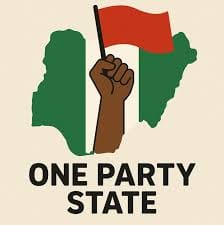
Democracy is not designed to whisper—it is meant to argue, to challenge, to compete. It survives on the oxygen of choice and the friction of opposing ideas. But when one political party begins to tower over all others, drowning out alternative voices, democracy does not merely weaken—it begins to suffocate. That is the uncomfortable reality Nigeria is inching toward, and it demands urgent attention.
Nigeria may not wear the official label of a one-party state, but the signs of creeping dominance are too glaring to ignore. When a single party controls vast stretches of power—across the executive, legislature, and many states—the political landscape starts to resemble a monopoly.
Opposition parties, once vibrant and combative, risk becoming shadows of themselves—divided, ineffective, and increasingly irrelevant. And when that happens, elections lose their essence. They stop being a genuine contest of ideas and start looking like rehearsed rituals with predictable outcomes.
The most immediate casualty of this imbalance is accountability. In a healthy democracy, leaders are kept on their toes by the constant threat of being voted out. That fear forces performance, responsiveness, and at least a measure of humility. But when one party becomes so dominant that it faces little to no credible challenge, that pressure evaporates. Power grows comfortable.
Leaders grow distant. Governance becomes less about service and more about survival within a closed political circle. For ordinary Nigerians, this often translates into broken promises, worsening public services, and a deepening sense of abandonment.
Even more troubling is what this dominance does to institutions. Strong democracies are built on independent pillars—the judiciary, electoral bodies, anti-corruption agencies—designed to check excesses and uphold fairness. But when one party’s influence stretches too far, these institutions risk becoming extensions of political power rather than guardians of the public interest. Decisions begin to raise eyebrows. Trust erodes. Citizens start to wonder whether justice is still blind or simply looking the other way.
Then comes the quiet but dangerous silencing of dissent. Democracy is not just about casting votes; it is about the freedom to question, to criticize, and to demand better. Yet in an environment where one party dominates, opposing voices can be pushed to the margins—sometimes subtly, sometimes forcefully. Critics may face intimidation, exclusion, or simply be ignored into irrelevance. Over time, a culture of fear and resignation can take hold, where people choose silence not because they agree, but because they feel speaking up is futile—or risky.
Policy-making also suffers under such dominance. Nigeria is a nation of immense diversity, with complex social, ethnic, and religious dynamics. No single viewpoint can adequately capture its realities. But when political competition fades, so does the diversity of ideas feeding into governance.
Policies risk becoming narrow, disconnected, and, at times, biased—serving select interests while alienating others. This is a dangerous path, one that can deepen divisions and sow seeds of long-term instability.
Perhaps less visible, but equally damaging, is the rise of political apathy. When citizens begin to believe that outcomes are predetermined, that their votes no longer carry weight, they disengage. Voter turnout drops. Civic participation declines.
Democracy, in essence, begins to hollow out from within. Nigeria, already grappling with fragile public trust in its political system, can ill afford this level of disengagement.
History offers a stark warning. Prolonged dominance by a single political force often leads to the concentration of power in the hands of a few. And where power concentrates unchecked, abuse is never far behind. Authoritarian tendencies do not always arrive with dramatic announcements—they creep in quietly, normalizing excess, eroding freedoms, and weakening democratic safeguards bit by bit. Nigeria’s own past, marked by military rule, should serve as a constant reminder of how easily hard-won freedoms can slip away.
But this trajectory is not inevitable. The drift toward one-party dominance is often a symptom of deeper structural problems—fractured opposition parties, lack of internal democracy, and a political culture heavily influenced by money and patronage. These are issues that can, and must, be addressed.
Opposition parties, for one, must rise to the occasion. They must move beyond internal squabbles and present clear, credible alternatives that resonate with the people. Electoral reforms are equally critical—ensuring transparency, fairness, and a level playing field for all political actors. Civil society and the media must remain vigilant, amplifying diverse voices and holding power accountable without fear or favour.
Yet, the ultimate responsibility rests with the Nigerian people. Democracy is not a spectator sport. It requires participation, awareness, and, above all, courage.
Citizens must resist the normalization of political dominance and continue to demand choice, accountability, and justice. Silence, in moments like this, is not neutrality—it is surrender.
Nigeria’s democracy is still evolving, still finding its footing. But the warning signs are clear. When one voice grows too loud, it risks drowning out the chorus that democracy depends on. The goal must never be the supremacy of one party, but the coexistence of many—each challenging,
refining, and strengthening the system.
Because in the end, a democracy where only one voice truly matters is not a democracy at all. It is something far more dangerous.
*Aminu is the Executive Director, Volunteer Media Advocacy for Accountable Leadership, Nigeria, augustineaminu@gmail.com