
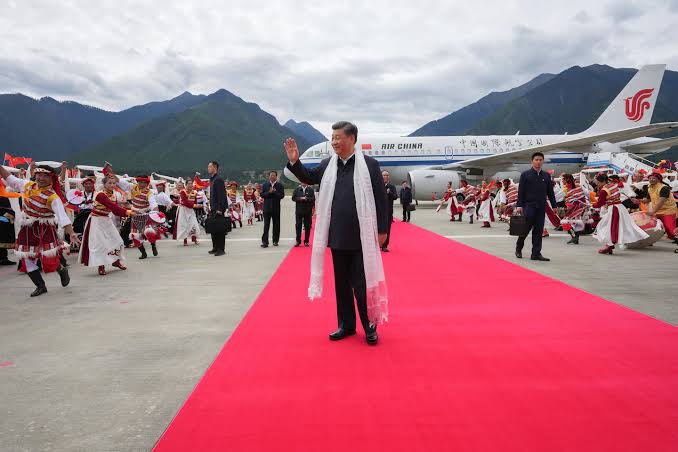
Chinese President Xi Jinping traveled to Tibet on Wednesday, August 20, 2025, to mark the 60th anniversary of Beijing’s formal establishment of control over the Himalayan territory.
State media reported that Xi arrived in the regional capital, Lhasa, where he was greeted by crowds waving flowers and performing traditional dances.
During his visit, Xi called for the creation of what he described as a “modern socialist Tibet” characterized by prosperity, unity, and stability.
China’s military occupation of Tibet in 1951 was followed by the establishment of the Tibet Autonomous Region in 1965 under Mao Zedong’s Communist Party.
Since then, Beijing has maintained tight political control.
Authorities have been accused of suppressing Tibetan religious and cultural expression, demolishing monasteries, and jailing monks.
In recent years, large numbers of Han Chinese settlers have moved into the region, while children have been placed in Mandarin-language boarding schools away from their families.
Beijing also claims authority over the reincarnation of the Dalai Lama, Tibetan Buddhism’s highest spiritual leader, who fled to India in 1959 after a failed uprising.
Now 90 years old, he remains in exile and continues to be a central figure for Tibetans resisting Chinese rule.
Xi’s visit came a day after Tibetan activists in India staged protests against China’s foreign minister.
Exiled groups argue that repression has intensified since Beijing’s crackdown on demonstrations in 2008, while Chinese officials maintain they have reduced poverty and expanded infrastructure across the plateau.
Tibet also plays a growing strategic role for China. Its southern border touches India, where Beijing has been building roads, military outposts, and other facilities in a region that has seen frequent border clashes in recent years.