
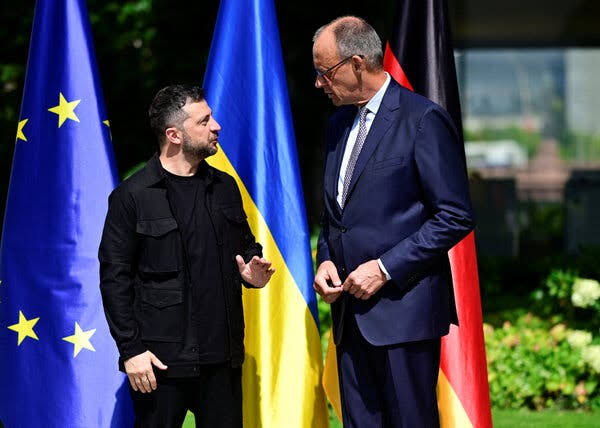
President Volodymyr Zelensky of Ukraine engaged in a week of intense diplomacy after a call with U.S. President Donald Trump raised concerns about Russia’s proposed peace plan.
The discussions followed Zelensky’s visit to the front lines in the northeastern Sumy region, where Ukrainian soldiers continue to resist Russian assaults.
During the call, Trump outlined a potential deal in which Russia would halt hostilities in exchange for a territorial exchange.
While the proposal initially appeared vague, it immediately sparked concern in Kyiv that Ukraine might be forced to cede land to Russia and allow President Vladimir Putin to escape international isolation.
Following the call, Zelensky sought to clarify the details of Moscow’s proposal. Ukrainian officials discovered that the plan involved Ukraine relinquishing parts of the Donbas region in return for a cease-fire elsewhere, without Russia giving up any territory it controls.
Kyiv viewed this as a strategic threat, as losing the Donbas would compromise Ukraine’s main defensive belt and strengthen Russian military positioning for future offensives.
Throughout the week, Zelensky and his top advisers communicated with nearly 30 world leaders to prevent Ukraine from being sidelined in negotiations.
Kyiv coordinated closely with European allies to form a unified stance and relay its position to the U.S., emphasizing that any peace deal must begin with a cease-fire, maintain current frontlines as the baseline, and include security guarantees for Ukraine.
In addition to phone calls, senior officials from Ukraine and Europe met with U.S. representatives, including Vice President JD Vance, in London to discourage a behind-the-scenes agreement with Russia.
Zelensky also traveled to London to meet Prime Minister Keir Starmer, continuing efforts to secure support before Trump’s scheduled summit with Putin in Alaska.
Despite the uncertainty, Zelensky emphasized that Ukraine remains committed to exploring solutions but will not voluntarily surrender territory.
The Ukrainian president acknowledged the complexity of territorial discussions, noting that any potential exchanges must be tied to comprehensive security guarantees.
Kyiv’s strategy reflects a continuation of its approach throughout the war: leveraging European support and consistent diplomacy to maintain influence over international negotiations and protect national sovereignty.