
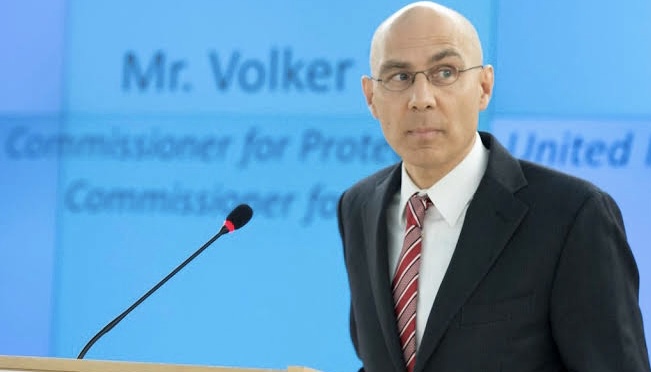
UN high commissioner for human rights, Volker Türk, has launched a $400 million appeal for 2026 as his office continues to operate “in survival mode”.
Mr Türk, who launched the appeal on Thursday in Geneva, said human rights couldn’t wait. He, however, warned member states that with crises mounting, the world couldn’t afford a human rights system in crisis.
In 2025, UN human rights staff in 87 countries observed more than 1,300 trials, supported 67,000 survivors of torture, documented tens of thousands of human rights violations, and contributed to the release of more than 4,000 people from arbitrary detention.
They also documented civilian casualties and informed humanitarian responses through risk analysis and early warning in 21 armed conflicts worldwide.
For example, the UN Human Rights Monitoring Mission in Ukraine is the only organisation that has maintained a comprehensive record of civilian casualties since Russia first invaded the country in 2014.
“In Sudan, we are providing vital support to survivors of sexual violence and other horrific atrocities, paving the way for justice and accountability,” he said.
Mr Türk also stressed that addressing inequalities and respecting economic and social rights are vital to peace and stability.
Mr Türk’s office worked with more than 35 governments in 2025, helping them to align all economic policies with human rights. He cited the example of Djibouti, where staff helped conduct a human rights analysis of the health budget, with a focus on people with disabilities.
The UN General Assembly has approved a regular budget of $224.3 million, which is based on assessed contributions from Member States. This amount is 10 per cent lower than in 2025.
Through the 2026 appeal, OHCHR is requesting an additional $400 million in voluntary contributions.
“Historically, human rights account for an extremely small portion of all UN spending. We need to step up support for this low-cost, high-impact work that helps stabilise communities, builds trust in institutions, and supports lasting peace,” Mr Türk said. “We need more unearmarked and timely contributions so we can respond quickly, as human rights cannot wait.”
(NAN)